

Mon-Fri 9am-6pm PST
+1 (800) 686-5898
support@longevitybased.com
Mon-Fri: 9am-6pm PST

TL;DR:
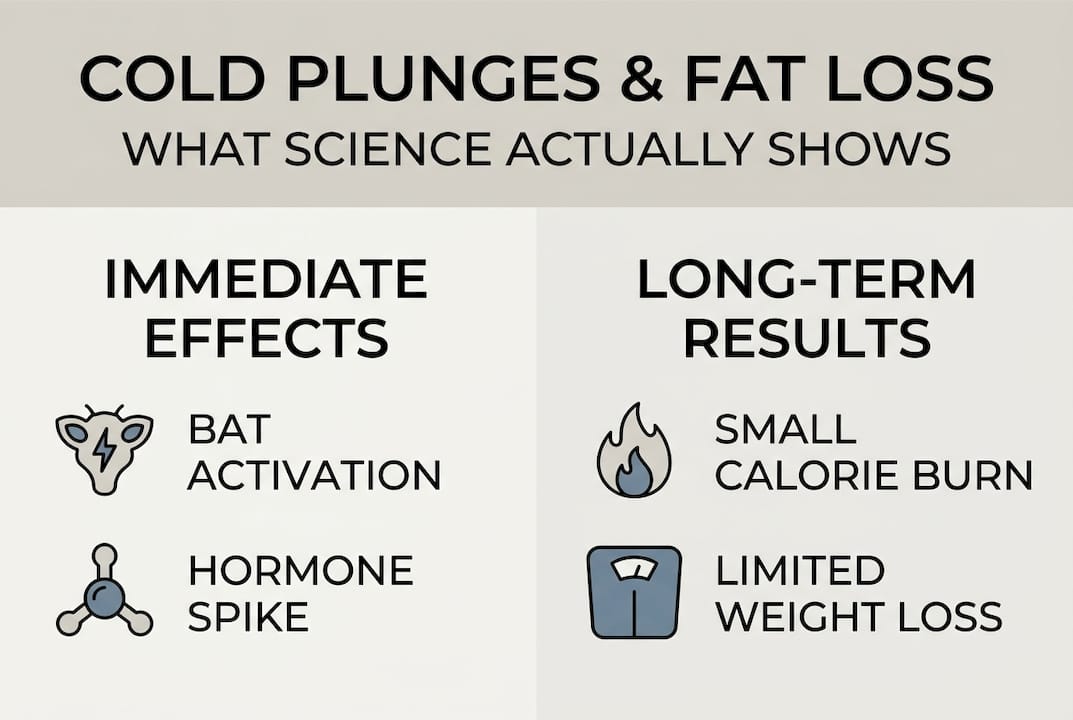
- Cold plunges activate brown fat and increase calorie burn temporarily but do not lead to significant weight loss.
- Most weight loss from cold exposure is offset by increased appetite and food intake.
- Cold plunges are best for recovery, mood, and resilience, not as a standalone fat-loss method.
Cold plunges are everywhere right now. Social media is flooded with claims that a few minutes in frigid water will melt fat, rev your metabolism, and reshape your body. The reality is more nuanced. While cold immersion does trigger real physiological responses, including brown fat activation and a temporary calorie burn, recent research makes clear that the weight loss benefits are modest at best. This guide breaks down exactly what the science says, where the hype diverges from the data, and how you can use cold plunges strategically as part of a broader biohacking routine.
| Point | Details |
|---|---|
| Temporary metabolism boost | Cold plunges increase your calorie burning for a few hours but don’t cause major long-term weight loss. |
| Evidence is mixed | Clinical studies show that cold exposure alone rarely leads to lasting fat loss without diet and lifestyle changes. |
| Mind your appetite | After cold plunges, you may feel hungrier and eat more, which can offset the calories burned during the session. |
| Best for recovery | Cold plunges support post-exercise recovery and mental clarity more than they directly melt body fat. |
When your body hits cold water, it has one immediate priority: maintain core temperature. To do that, it activates brown adipose tissue (BAT), a specialized fat that burns calories to generate heat rather than storing energy like white fat does. This process is called non-shivering thermogenesis, and it is one of the most discussed mechanisms in cold exposure research.
BAT activation triggers a release of norepinephrine, a hormone that ramps up metabolic rate and fat oxidation. The result is a measurable, though temporary, increase in calorie expenditure. According to a 2025 meta-analysis, cold plunges activate BAT and increase non-shivering thermogenesis, resulting in a 50 to 200 kcal energy expenditure increase per session. That range is wide because body composition, water temperature, and session duration all influence the outcome.
Not everyone responds equally. Research shows that lean adults see greater BAT activation and energy expenditure increases than obese individuals. This is partly because leaner people have more metabolically active BAT and less insulating subcutaneous fat. For someone with higher body fat, the thermogenic response is blunted.
Here is a simplified look at how cold exposure compares across different user profiles:
| User profile | BAT activation level | Estimated calorie burn per session |
|---|---|---|
| Lean young adult | High | 100 to 200 kcal |
| Average adult | Moderate | 50 to 150 kcal |
| Obese individual | Low | 20 to 80 kcal |
“The metabolic boost from cold exposure is real but short-lived. It spikes during and immediately after immersion, then returns to baseline within a few hours.”
Key metabolic effects of cold plunges include:
Understanding these cold exposure myths helps set realistic expectations. The metabolic effects are real, but they are not large enough on their own to drive meaningful fat loss. Timing also matters, and cold plunge timing can influence how much thermogenic benefit you actually capture.
With the metabolic mechanisms established, the next question is straightforward: do cold plunges actually make people lose weight? The clinical data is sobering for anyone hoping the answer is yes.
Multiple controlled trials and reviews have examined this question directly. The findings are consistent. Clinical trials show no consistent reduction in weight or body fat from cold plunges alone, and any increased calorie burn is often offset by higher food intake afterward. That last point is critical and frequently overlooked in social media discussions.
A key reason the calorie math fails is compensatory eating. Research from Coventry University found that cold exposure increases appetite, and participants commonly ate more after cold plunges, effectively nullifying the calorie deficit. The body is remarkably good at defending its energy stores, and cold is one of the triggers that can push hunger upward.
A Harvard cold plunge review echoes this finding, noting that while cold water immersion offers recovery and mood benefits, the evidence for fat loss specifically remains weak. Multiple reviews confirm minimal net energy balance impact across repeated cold plunge sessions when diet is not controlled.
Here is how the real-world outcomes compare to common expectations:
| Claimed benefit | What research shows |
|---|---|
| Significant fat loss | Not supported without diet changes |
| Permanent metabolism boost | Temporary only, hours not days |
| Appetite suppression | Often the opposite occurs |
| Recovery improvement | Well-supported across studies |
| Mood and alertness | Consistently supported |
Pro Tip: If you are using cold plunges as part of a weight loss strategy, track your food intake for a week after starting. Many people unconsciously eat more without realizing it, which explains why the scale does not move despite consistent plunging.
Here is a numbered breakdown of what research actually supports:
If you want to learn how to cold plunge safely and effectively, the protocol matters far more than most people realize.
The gap between social media claims and published research is wide. Understanding exactly where the myths live helps you make smarter decisions about your biohacking routine.
Myth: Cold plunges dramatically boost your metabolism. Some promotional content suggests cold exposure can raise metabolic rate by 10 to 15%. In practice, trials show smaller, short-lived increases, and the effect fades within hours. The 10 to 15% figure is an outlier, not the norm.
Myth: Activating brown fat guarantees fat loss. BAT activation burns calories, but the amounts are modest. Even at the high end of 200 kcal per session, that is roughly the equivalent of a small snack. If appetite increases to compensate, the net effect on body composition is negligible.
Myth: Colder is always better. Protocol specifics matter enormously. Temperature, duration, and frequency all interact. Extremely cold water for very short periods may actually produce less thermogenic benefit than slightly milder temperatures held for longer.
Reality: Cold plunges excel at recovery and mental performance. The evidence for reduced delayed-onset muscle soreness (DOMS), improved alertness, and mood enhancement is genuinely strong. These are the outcomes you can count on.
Key factors that shape your actual results:
Pro Tip: Use cold plunges as a recovery and performance tool first, and a potential metabolic support tool second. Stacking them with resistance training and a caloric deficit is where you will see body composition changes.
Reading through the cold fat-burning myths in detail can save you from building a routine around expectations the science does not support.
If you want cold plunges to contribute meaningfully to your wellness goals, the approach matters. Here is a practical framework grounded in what the research actually supports.
Pro Tip: Review science-backed cold plunge timing to fine-tune when and how long you plunge based on your specific goals. The Cleveland Clinic also offers practical safety guidance worth reviewing before starting.
Here is an uncomfortable observation: much of the enthusiasm around cold plunges and fat loss is driven by anecdote, not data. People who start cold plunging often simultaneously clean up their diet, add exercise, and improve sleep. When they lose weight, they credit the cold. The cold gets the headline; the caloric deficit does the actual work.

This matters because it shapes how people allocate their time and energy. Spending significant mental bandwidth optimizing cold plunge protocols while neglecting nutrition is a poor trade. The research on cold plunge fat-burning myths is clear: recovery, mood, and habit formation are where cold exposure genuinely earns its place in a biohacking routine.
The smarter framing is to treat cold plunges as a high-value recovery and resilience tool that supports a broader, sustainable wellness system. That is where the real longevity payoff lives.
If you are ready to integrate cold therapy into a science-backed routine, the right equipment makes a meaningful difference. At Longevity Based, you will find a curated selection of cold plunge systems designed for consistent temperature control and safe, effective immersion. For those building a full recovery stack, explore our recovery tools that complement cold therapy with additional modalities like red light and compression. Every product on longevitybased.com is selected with performance, safety, and longevity in mind, giving you the tools to build routines that actually hold up to scrutiny.
No. Studies consistently show that no consistent fat reduction occurs from cold plunges alone without accompanying dietary or activity changes.
Most sessions burn approximately 50 to 200 extra calories, depending on protocol and body type, as confirmed by 2025 meta-analysis data on brown fat thermogenesis.
The boost is temporary. It peaks during and shortly after immersion, and acute cold exposure effects on metabolism do not accumulate significantly over time without sustained dietary support.
Yes. Risks include increased appetite that can offset calorie burn, shivering, and in rare cases cardiovascular stress. The Cleveland Clinic recommends following safe protocols, especially for those with heart conditions.
Lean young adults benefit most. Research confirms that lean adults show greater BAT activation and energy expenditure response compared to obese individuals, who show a blunted thermogenic effect.


