

Mon-Fri 9am-6pm PST
+1 (800) 686-5898
support@longevitybased.com
Mon-Fri: 9am-6pm PST

TL;DR:
- Scientific evidence supports around 11 minutes of cold plunging weekly across 2-4 sessions.
- Doubling the frequency often leads to diminishing benefits and potential health risks.
- Moderate, well-structured routines optimize recovery, neurochemical responses, and safety.
Cold plunging twice a day sounds like the ultimate recovery hack, but the science tells a more nuanced story. While cold water immersion has earned its place in serious performance and longevity routines, popular wellness culture has a tendency to push frequency well beyond what research actually supports. Optimal cold exposure sits at roughly 11 minutes total per week, distributed across 2 to 4 sessions at uncomfortably cold but safe temperatures. That benchmark alone raises real questions about doubling up daily. This article breaks down what the evidence says, who might benefit, who should hold back, and how to structure a routine that actually works.
| Point | Details |
|---|---|
| Moderation is key | Optimal cold plunging frequency is less than most trends suggest, around 2-4 sessions per week. |
| Twice daily risks | Frequent cold plunging can cause fatigue, immune suppression, and slower muscle recovery if unmanaged. |
| Tailor for your needs | Beginners and vulnerable individuals should start slow, while advanced users must monitor health closely. |
| Evidence first | Current scientific studies recommend prioritizing safe temperatures, moderation, and gradual increases. |
Having introduced the debate, let’s clarify what science actually says about how often cold plunges are beneficial. The research landscape here is more specific than most wellness content suggests, and understanding the minimum effective dose is the right starting point.
Andrew Huberman’s widely cited protocol recommends 11 minutes weekly, spread across 2 to 4 sessions rather than crammed into daily or twice-daily routines. This is not an arbitrary number. It reflects the threshold at which cold exposure reliably triggers meaningful physiological adaptations without pushing the body into a stress state that undermines recovery. Exceeding this threshold, especially for beginners, can shift cold plunging from a recovery tool into a physiological stressor.
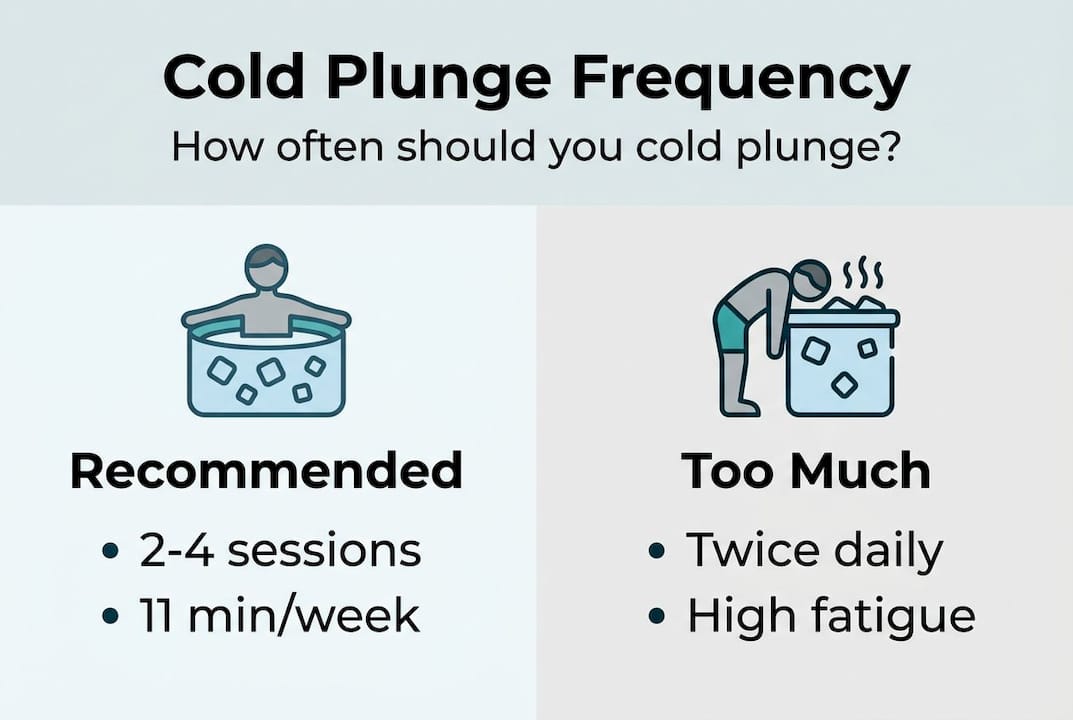
The neurochemical angle is particularly compelling. Studies show 11 min/week optimizes dopamine and norepinephrine release, two neurotransmitters central to mood, motivation, and focus. These hormones spike sharply after cold exposure and remain elevated for hours. But repeating that stimulus too frequently may blunt the response over time, a phenomenon known as habituation.
Here is a quick reference for how session frequency maps to physiological outcomes:
| Sessions per week | Experience level | Expected outcome |
|---|---|---|
| 2 to 3 | Beginner | Adaptation, mood lift, mild recovery support |
| 3 to 4 | Intermediate | Optimized neurochemical response, recovery |
| 7 to 14 (twice daily) | Advanced only | Risk of diminishing returns, fatigue |
Key takeaways from the frequency research:
The bottom line from the science: more frequent is not more effective. Twice-daily plunging pushes well beyond the evidence-supported dose for most people.
With baseline science established, let’s look at what actually happens when you double up cold plunges daily. The picture is more complicated than either enthusiasts or skeptics tend to acknowledge.
Potential benefits for advanced users:
These benefits are real, but they come with significant caveats. Higher frequencies suit advanced users but risk diminishing returns, slowed muscle repair, immune suppression, and thermoregulatory fatigue if not carefully managed. That last point deserves attention. Thermoregulatory fatigue occurs when the body’s ability to maintain core temperature becomes compromised through repeated thermal stress, and it is not always obvious until it has already set in.
| Factor | Benefit (advanced users) | Risk (general population) |
|---|---|---|
| Recovery speed | Faster between sessions | Slowed muscle repair |
| Immune function | Short-term boost | Suppression with overuse |
| Neurochemical response | Elevated dopamine | Habituation and blunting |
| Thermoregulation | Improved cold tolerance | Fatigue and instability |
“The goal is not to maximize cold exposure. It is to find the minimum effective dose that produces the desired adaptation.” This framing, consistent with Huberman’s approach to cold exposure, applies directly to frequency decisions.
Pro Tip: If you are considering twice-daily sessions, track your resting heart rate and sleep quality daily. Elevated resting heart rate or disrupted sleep are early signs that your nervous system is under too much stress.
Understanding cold exposure benefits in context matters here. Cold plunging is one recovery modality among several, and stacking it with tools like sauna therapy often produces better outcomes than doubling cold exposure alone. Contrast therapy, alternating between heat and cold, is a well-supported approach that avoids the risks of excessive cold-only protocols.

Understanding the risks, let’s pinpoint who might benefit and who should avoid frequent cold plunges. This is where individual factors become the deciding variable.
Who may be suited for twice-daily cold plunging:
Who should not cold plunge twice a day:
Beginners should not attempt twice daily cold plunging. The recommendation is to start with fewer sessions per week and consult a doctor if you have heart or lung conditions, are pregnant, or are new to the practice entirely. This is not overcaution. Cold water immersion triggers an immediate cardiovascular response, including a sharp drop in heart rate followed by vasoconstriction, that can be dangerous for those with underlying conditions.
For those who are cold plunging during pregnancy, twice-daily sessions are not appropriate under any circumstances. The physiological demands are simply too high.
“There are no large randomized controlled trials specifically examining twice-daily cold plunging.” The evidence supports a cautious yes only for well-adapted, healthy individuals, not as a blanket recommendation.
Pro Tip: Before increasing to twice-daily sessions, spend at least 8 to 12 weeks at 3 to 4 sessions per week. If your recovery, sleep, and energy remain strong throughout, you may be a candidate for increased frequency. If any of these markers dip, hold your current protocol.
Reviewing a solid cold plunge guide before increasing frequency is a practical first step for anyone considering this progression.
Now that you know who it’s for, here’s how to implement cold plunging successfully and safely. Structure matters as much as frequency.
Beginners should start with 2 to 3 sessions per week at warmer temperatures (around 55 to 60 degrees Fahrenheit) and shorter durations of 1 to 2 minutes. This allows the body to adapt gradually without triggering the stress responses associated with overexposure. Progression should be earned, not assumed.
Practical guidelines for building a safe routine:
Pro Tip: Use a simple 1 to 5 scale to rate your energy and mood each morning before your plunge. If your average score drops over a 5-day period, reduce frequency immediately.
Reviewing cold plunge steps and understanding cold plunge timing science will help you build a protocol grounded in evidence rather than trend-chasing.
Having laid out the science and practical tips, here’s our nuanced perspective. The wellness space has a recurring problem: it takes a genuinely effective tool and pushes it to excess, assuming that more intensity always produces more benefit. Cold plunging is not immune to this pattern.
The honest reality is that most people who are cold plunging twice a day are not doing so because the evidence supports it. They are doing it because it feels productive. There is a meaningful difference between those two motivations.
Expert opinions stress moderation and caution, not excess. The physiological adaptations that make cold exposure valuable, improved resilience, neurochemical optimization, faster recovery, are best cultivated through consistent, well-dosed exposure over time. Chasing frequency beyond what your body can absorb does not accelerate those adaptations. It reverses them.
The most effective cold plunging routines we see are not the most aggressive ones. They are the most intentional. Review the cold plunge evidence and build your protocol around what the data actually supports, not what the trend cycle promotes.
Ready to make your recovery routine smarter? At Longevity Based, we offer a curated selection of recovery tools designed to support safe and effective cold plunging alongside complementary modalities like red light therapy, infrared saunas, and EMS devices. Whether you are building your first cold plunge routine or refining an advanced protocol, the right equipment makes a measurable difference. Explore the full range of longevity products at Longevity Based to find solutions that align with your performance and recovery goals. Our offerings are selected for scientific credibility and practical effectiveness, so you can optimize your healthspan with confidence.
Twice-daily cold plunging is generally safe for healthy, well-adapted individuals but carries real risks including fatigue, slowed recovery, and immune suppression if not carefully managed. Higher frequencies suit advanced users only.
No. Beginners should start with 2 to 3 sessions per week at warmer temperatures and short durations, increasing frequency only after consistent adaptation over several weeks.
Key warning signs include persistent fatigue, slowed muscle recovery, frequent illness, and difficulty regulating body temperature. Thermoregulatory fatigue and immune suppression are the most clinically significant risks.
Some advanced users report improved recovery, but 11 min/week optimizes performance-related neurochemicals at lower frequencies. Doubling up often produces diminishing returns rather than additive gains.
Aim for 2 to 4 sessions weekly, 1 to 5 minutes each, within the 50 to 59 degree Fahrenheit range. Start slow and increase only as tolerated, and consult a physician if you have any underlying health conditions.


