

Mon-Fri 9am-6pm PST
+1 (800) 686-5898
support@longevitybased.com
Mon-Fri: 9am-6pm PST

TL;DR:
- Sauna therapy reduces inflammation, improves circulation, and decreases oxidative stress in arthritic joints.
- Clinical studies show sauna can significantly lessen arthritis pain and stiffness short-term without worsening condition.
- Safe sauna use involves gradual routines, careful monitoring, and consulting healthcare providers, especially during flares.
For anyone managing arthritis, the idea of sitting in a hot sauna can feel counterintuitive—even risky. Yet sauna therapy provides short-term relief from arthritis pain, stiffness, and fatigue without worsening disease activity. That finding challenges a widespread assumption that heat will aggravate inflamed joints. This guide covers exactly how sauna therapy interacts with arthritic joints, what clinical research actually shows, who should and should not use it, and how to build a practical routine that gets results safely. Whether you have rheumatoid arthritis, ankylosing spondylitis, or osteoarthritis, the evidence points to a real, accessible tool worth understanding.
| Point | Details |
|---|---|
| Eases arthritis pain | Sauna use can quickly reduce joint pain and stiffness for many with arthritis. |
| Best for stable symptoms | You should avoid sauna during acute arthritis flares or if you have major heart conditions. |
| Short, regular sessions | 2-4 times weekly for 10-20 minutes delivers the best balance of relief and safety. |
| Not a cure | Sauna is a supportive therapy—combine with doctor’s care and do not expect full remission. |
| Consult your doctor | Ask your provider before starting sauna routines, especially if you have other medical concerns. |
Heat does more than warm your skin. Inside arthritic joints, a series of measurable biological changes occur during sauna exposure that directly address the root drivers of pain and stiffness.
The most significant process involves inflammation control. Heat therapy reduces pro-inflammatory markers including TNF-α, C-reactive protein (CRP), prostaglandin E2 (PGE2), and leukotriene B4 (LTB4), while simultaneously promoting the release of interleukin-10 (IL-10), a potent anti-inflammatory signaling molecule. In simpler terms, heat helps your body switch from an inflammatory mode toward a recovery mode.
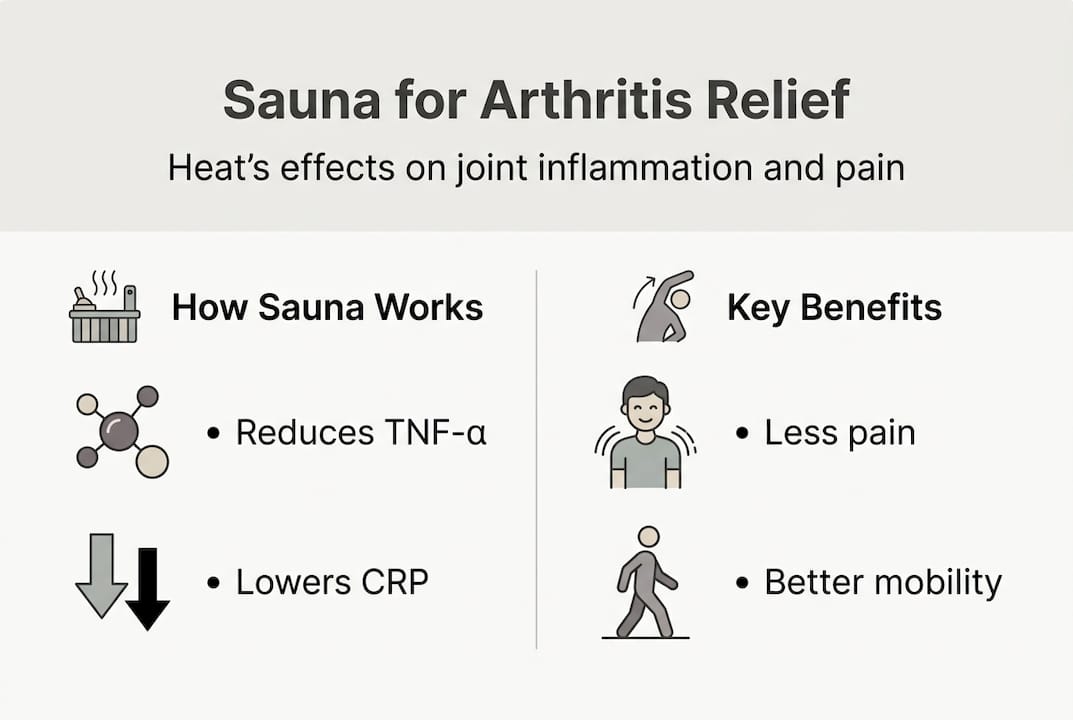
Circulation improvement matters just as much. When body temperature rises, blood vessels dilate and blood flow to peripheral tissues increases. For arthritic joints, this means better delivery of oxygen and nutrients and faster clearance of metabolic waste products. The same sauna effects on muscle recovery that benefit athletes also support joint tissue in people with inflammatory arthritis.
Oxidative stress is another key target. Chronic arthritis generates elevated levels of reactive oxygen species (free radicals), which damage joint tissue over time. Repeated sauna sessions appear to lower oxidative stress markers, reducing this ongoing tissue burden.
“Thermal therapy mechanisms produce rapid, measurable changes in inflammation markers and joint mobility, paralleling benefits seen with warm water hydrotherapy but with greater convenience and scalability.”
Here is a quick breakdown of the core mechanisms at work:
These mechanisms work together, which is why the benefits of sauna for arthritis go beyond simple heat-based comfort. It is a physiological intervention with real biochemical effects.
| Mechanism | Effect on arthritis |
|---|---|
| Reduced TNF-α and CRP | Lower systemic inflammation |
| Increased IL-10 | Enhanced anti-inflammatory signaling |
| Improved circulation | Better joint tissue repair |
| Reduced oxidative stress | Less ongoing joint tissue damage |
| Muscle relaxation | Decreased secondary pain and stiffness |
Understanding the science is one thing. What does clinical evidence say about real outcomes for people living with arthritis?
The most cited study comes from Oosterveld et al. (2009), a pilot study in which 17 rheumatoid arthritis (RA) patients and 17 ankylosing spondylitis (AS) patients underwent eight infrared sauna sessions over four weeks. RA patients experienced roughly a 40% reduction in pain scores. AS patients saw approximately 60% pain reduction, with statistical significance at p<0.001. Stiffness improved significantly (p<0.05). Critically, no adverse effects occurred and disease activity scores (DAS28 for RA, BASDAI for AS) remained stable throughout.
Key stat: Not a single participant experienced disease worsening during the study period.
Here is a clear comparison of outcomes reported:
| Measure | Before sauna | After 8 sessions |
|---|---|---|
| RA pain score (VAS) | High baseline | ~40% reduction |
| AS pain score (VAS) | High baseline | ~60% reduction |
| Stiffness (both groups) | Significant impairment | Significant improvement |
| Disease activity (DAS28/BASDAI) | Stable | Remained stable |
Beyond pain reduction, participants reported improved fatigue and overall sense of wellbeing. That matters for people whose arthritis affects daily function and quality of life, not just measured pain scores.

However, the evidence has real limitations that any honest review must acknowledge. The current research base consists mostly of small pilot studies with limited controls. Larger randomized controlled trials are still needed to confirm these effects at scale and across diverse populations.
Here is how the evidence stacks up:
The bottom line: results are promising and the safety profile is strong, but expectations should be realistic. Sauna helps manage symptoms and supports quality of life. It does not alter the underlying disease course.
Relief is only useful if the approach is safe. For most people with stable arthritis, sauna use is well-tolerated. But certain conditions and circumstances require caution or outright avoidance.
Sauna places cardiac stress on the body similar to moderate exercise. For healthy adults, that stress is manageable and even beneficial. For those with certain health conditions, it can be dangerous.
Who should avoid sauna:
The Arthritis Foundation recommends heat therapy during stable phases and cooling strategies during active flares. Following that framework for sauna use is sound practice.
For everyone else, the main risks are dehydration and overheating. Both are preventable with basic precautions.
Warning signs to exit the sauna immediately:
For a broader look at how to use heat exposure safely for long-term health, reviewing sauna safety guidance can help you build smart habits from the start.
Pro Tip: Always check with your rheumatologist or primary care physician before starting sauna therapy, especially if you take medications that affect blood pressure, heart rate, or fluid balance.
If you are ready to incorporate sauna into your arthritis care routine, structure and consistency matter more than intensity. Starting slowly and building gradually produces the best outcomes.
Sauna therapy for arthritis works best at two to four sessions per week, each lasting 10 to 20 minutes, particularly during periods of stable disease. That rhythm delivers consistent anti-inflammatory signaling without overtaxing the body.
Here is a step-by-step routine to follow:
For guidance on how often to use sauna for wellness goals, and how to calibrate safe sauna session length over time, those resources offer a solid evidence-based framework.
Pro Tip: Morning sessions may help reduce morning stiffness, which is one of the most disabling symptoms in rheumatoid and inflammatory arthritis. A 10 to 15 minute session before your usual activity period can prime joints for better range of motion throughout the day.
If you’re considering a dedicated home sauna setup, medical-grade sauna options are worth exploring for consistent, safe access.
Most guides on this topic swing between two extremes: enthusiastic overclaiming or dismissive skepticism. Neither serves people actually managing arthritis day to day.
Here is what the evidence and experience together suggest: sauna is a genuinely useful tool, not a miracle. Its real value lies in how it fits inside a broader, personalized wellness routine. Heat alone, applied without attention to your disease phase, health status, or individual tolerance, delivers far less benefit and carries real risk.
The people who get the most from sauna therapy are those who treat it the way they treat any other therapeutic practice: with gradual ramp-up, honest self-observation, and regular medical check-ins. They are not chasing a cure. They are optimizing comfort, mobility, and quality of life alongside their existing treatment plan.
What most guides miss is the science of listening to your body. No clinical trial can tell you exactly when you benefit most, at what temperature, or at which point in your symptom cycle. That precision comes from tracking your own patterns over weeks. Blending the science of heat therapies with careful self-observation is what separates smart users from those who either quit early or push too hard.
If you approach sauna therapy with realistic expectations and proper safety habits, it becomes one of the more accessible, low-cost, and genuinely effective tools available for arthritis symptom management.
If you are exploring tools to support your arthritis care alongside sauna therapy, a few options at Longevity Based are worth your attention. Therasage infrared saunas are specifically designed for therapeutic use, offering precise temperature control and full-spectrum infrared wavelengths that match the parameters used in clinical research. For targeted joint areas, portable red light therapy delivers photobiomodulation directly to painful tissue, complementing the systemic effects of sauna use. Broader recovery tools for arthritis including massage devices and muscle stimulation equipment round out a complete, science-backed approach to pain management and daily function support.
Sauna use is unlikely to worsen stable arthritis and often provides meaningful pain relief, but it should be avoided during acute joint flares, major health events, or if you notice symptom worsening during or after sessions.
Most clinical evidence supports 10 to 20 minute sessions two to four times per week as the optimal starting range for arthritis relief without overexposure.
Avoid sauna if you have unstable cardiac conditions, recent heart attack or stroke, uncontrolled high blood pressure, are pregnant, or are currently in an active arthritis flare with joint swelling.
Infrared saunas may penetrate tissue more deeply and operate at lower ambient temperatures, making them more comfortable for some users. Both types show short-term pain relief for arthritis when used safely.
Sauna reliably helps reduce symptoms but does not alter the underlying disease. It is adjunctive, not curative, and works best as part of a comprehensive arthritis management plan.


