

Mon-Fri 9am-6pm PST
+1 (800) 686-5898
support@longevitybased.com
Mon-Fri: 9am-6pm PST

TL;DR:
- Red light therapy may improve nerve function, reduce pain, and support nerve repair in neuropathy.
- Consistent application of specific wavelengths and parameters is essential for effective results.
- PBM offers a safe, evidence-backed addition to traditional neuropathy management strategies.
Neuropathy symptoms, whether burning feet, tingling hands, or sharp nerve pain, are notoriously resistant to standard treatments. Most people assume medication is the only reliable path forward. But emerging clinical data suggests photobiomodulation (PBM), commonly called red light therapy, may improve nerve function, reduce pain, and support nerve repair in measurable ways. This guide covers the science, the real clinical evidence, practical protocols, and honest limitations so you can make an informed decision about whether PBM belongs in your neuropathy management strategy.
| Point | Details |
|---|---|
| Evidence supports PBM | Multiple studies confirm red light therapy can reduce neuropathic pain and improve nerve function. |
| Safe with few risks | Red light therapy is well-tolerated with minimal side effects when used as directed. |
| Consistency is key | Best results occur with regular sessions, following evidence-based protocols. |
| Home and clinic options | Both at-home and clinical devices are effective if parameters are correct and safety is prioritized. |
Red light therapy, or photobiomodulation, uses specific wavelengths of light to stimulate biological processes at the cellular level. It is not heat therapy and it is not UV light. The wavelengths used in clinical and home settings typically fall within two ranges: 630–670 nm (visible red) and 808–904 nm (near-infrared). Each range penetrates tissue to different depths, with near-infrared reaching deeper structures including peripheral nerves.
The primary mechanism involves mitochondria. Light at these wavelengths is absorbed by cytochrome c oxidase, a key enzyme in the mitochondrial respiratory chain, which boosts ATP production. More cellular energy means faster repair cycles, reduced oxidative stress, and lower local inflammation. For peripheral nerves, this translates to a more favorable environment for regeneration and signal transmission.
Key mechanisms relevant to neuropathy include:
Typical treatment parameters in clinical trials use a fluence (dose) of 3–10 J/cm², power densities between 45–100 mW/cm², and a course of 10–12 or more sessions. Understanding the difference between infrared vs red light therapy wavelengths matters when selecting a device, since depth of penetration directly affects outcomes for nerve tissue.
PBM improves nerve function, pain, and biomarkers in diabetic neuropathy, confirming that the biological mechanisms translate into real clinical outcomes.
Pro Tip: Consistency is the single biggest predictor of results in PBM trials. Sporadic sessions produce minimal benefit. Commit to a structured protocol of at least 10 sessions before evaluating your response.
The clinical evidence base for PBM in neuropathy has grown substantially in recent years. Three major neuropathy categories have received the most research attention: diabetic peripheral neuropathy (DPN), chemotherapy-induced peripheral neuropathy (CIPN), and chronic neuropathic pain from conditions like fibromyalgia.

A 2025 RCT found significant improvements across several neuropathy metrics after 10 sessions of PBM, including reductions in the Neuropathy Pain Rating Scale (NPRS), improvements in the Michigan Neuropathy Screening Instrument (MNSI), and favorable changes in neuron-specific enolase (NSE), a biomarker of nerve damage. These are not subjective comfort scores alone; they reflect measurable biological change.
For CIPN, multiple RCTs support PBM with improvements in pain and physical function, making it a particularly relevant option for cancer survivors managing long-term nerve damage after treatment.
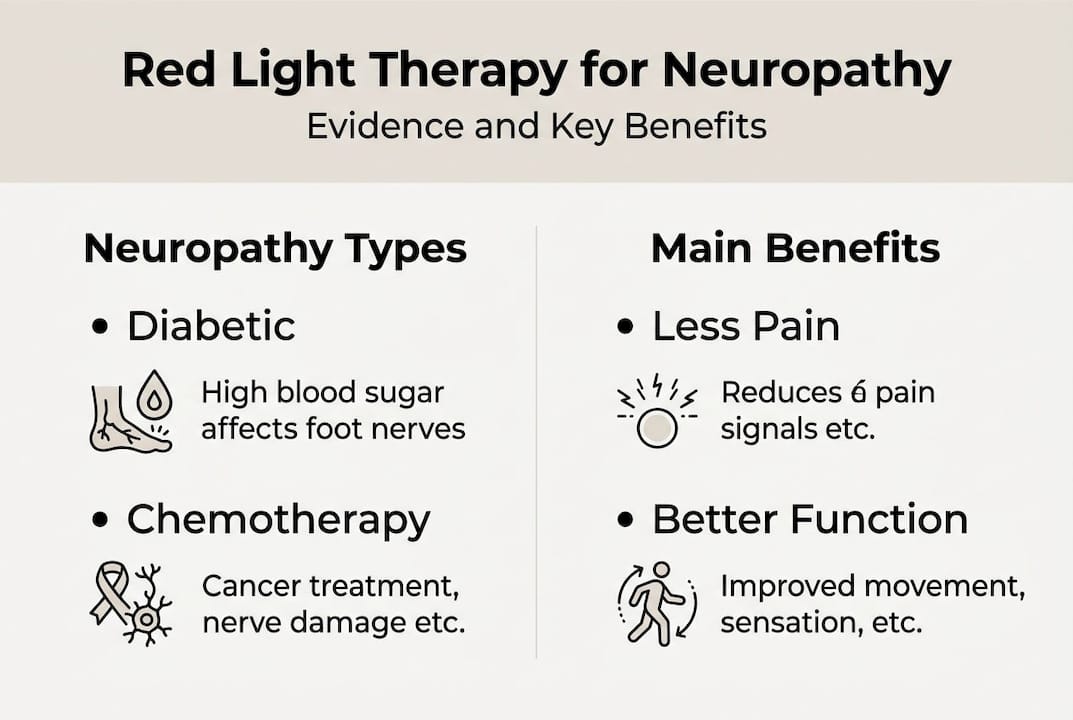
A 2026 systematic review found overall benefit for neuropathic pain across diverse patient groups, including fibromyalgia and diabetes cases, reinforcing that PBM’s effects are not limited to a single neuropathy subtype.
| Study type | Population | Key outcomes | Significance |
|---|---|---|---|
| RCT (2025) | Diabetic neuropathy | Improved NPRS, MNSI, NSE | Statistically significant |
| Meta-analysis (2026) | CIPN patients | Reduced pain, better function | Clinically meaningful |
| Systematic review (2026) | Mixed neuropathy | Broad pain reduction | Consistent across subtypes |
“Across multiple trial designs and neuropathy populations, PBM consistently demonstrates a favorable safety profile with meaningful reductions in pain and nerve damage markers.”
For those managing diabetic neuropathy specifically, the Neuropathy Support Kit is designed to address the hands and feet, the areas most commonly affected by peripheral nerve damage.
Key takeaways from the evidence:
Knowing the evidence is one thing. Applying it correctly is another. Poorly dosed or inconsistently applied PBM will not produce the results seen in clinical trials. Here is a practical framework based on current research.
Pro Tip: Track your symptoms using a simple 0–10 pain scale and note any changes in sensation, sleep quality, or mobility. This gives you objective data to share with your healthcare provider and helps you adjust your protocol.
For guidance on how often to use red light therapy and what constitutes overuse, reviewing established protocols is worthwhile before starting. Understanding red light therapy safety thresholds helps you avoid the common mistake of assuming more is always better.
| Factor | Home device | Clinical device |
|---|---|---|
| Cost | Lower upfront | Higher per session |
| Supervision | None | Expert-guided |
| Dosing precision | Variable | Calibrated |
| Convenience | High | Requires travel |
| Intensity | Moderate | Higher |
PBM is not a cure for neuropathy. It does not reverse the underlying disease causing nerve damage, whether that is diabetes, chemotherapy toxicity, or autoimmune processes. What it may do is meaningfully reduce symptoms, support nerve repair, and improve quality of life when used consistently and correctly.
Several important limitations deserve honest acknowledgment:
“PBM is safe with very few adverse events, but eye protection is required and use over active cancer sites is not recommended unless treating CIPN under clinical supervision.”
Always consult your healthcare provider before starting PBM, particularly if you are managing diabetes, active cancer, or taking medications that affect light sensitivity. PBM pairs well with other evidence-based approaches, and your provider can help integrate it appropriately. For those also dealing with wound complications from neuropathy, understanding red light therapy wound healing applications adds another dimension to its utility.
Here is something most guides will not tell you: the biggest barrier to results with PBM is not device quality. It is unrealistic expectations combined with inconsistent use. People try a few sessions, feel modest improvement, and either stop because it feels too slow or overdo it chasing faster results.
The evidence is genuinely encouraging, especially for diabetic and chemotherapy-induced neuropathy. But PBM works best as one layer in a broader strategy. Movement, blood sugar control, anti-inflammatory nutrition, and professional oversight all matter. Red light therapy is not a replacement for those fundamentals; it is an addition that can meaningfully accelerate nerve repair when the other variables are managed.
We also think the field is moving faster than most clinicians realize. Emerging guidelines for PBM are beginning to formalize what biohackers and early adopters have been testing for years. If you want to stay ahead of that curve, learning how to use red light therapy correctly now puts you in a strong position as protocols become more standardized.
Prioritize quality devices, follow evidence-based parameters, and give the therapy adequate time to work.
If you are ready to move from research to action, Longevity Based offers a curated range of red light therapy devices built for at-home use with clinical-grade specifications. These are not generic wellness gadgets. They are designed with the wavelength ranges, power outputs, and build quality that align with what the research actually supports.
For targeted neuropathy relief, the BioLight Glow device offers a portable, accessible entry point for consistent daily sessions. Whether you are managing diabetic neuropathy, CIPN, or chronic nerve pain, having a reliable, well-specified device makes adherence far easier and your results more predictable.
Most trials use 10 to 12 sessions as the minimum treatment window, which typically translates to 4–6 weeks of consistent use at 2–3 sessions per week before meaningful improvements are measurable.
PBM is well-tolerated for people with diabetes. For cancer patients, avoid therapy over active tumor sites but it can be used for chemotherapy-induced neuropathy under appropriate clinical supervision.
Home LED panels can produce meaningful results when properly dosed and used consistently, though clinical devices offer more precision in dosimetry and expert-guided protocol adjustments that home users must replicate manually.
No known drug interactions with PBM have been established, but you should always consult your healthcare provider before combining red light therapy with existing neuropathy medications or treatments.


