

Mon-Fri 9am-6pm PST
+1 (800) 686-5898
support@longevitybased.com
Mon-Fri: 9am-6pm PST

Wound healing can feel frustratingly slow, especially when you’re dealing with surgical incisions, chronic ulcers, or stubborn injuries that refuse to close. Traditional methods work, but they often leave you waiting weeks for visible progress. Red light therapy has emerged as a scientifically supported tool to accelerate tissue repair by stimulating cellular energy production and collagen synthesis. This guide walks you through the exact protocols, dosing parameters, and tracking methods you need to use red light therapy effectively at home for faster, more complete wound recovery.
| Point | Details |
|---|---|
| Wavelengths by depth | 630 to 670 nanometers target superficial wounds and 810 to 850 nanometers reach deeper tissue. |
| Irradiance threshold | Target irradiance is above 50 mW per cm squared to keep treatment times practical. |
| Dose progression | Begin with 2 to 4 J per square centimeter and gradually increase to 6 to 10 J per square centimeter as healing progresses. |
| Complement standard care | Red light therapy should complement standard wound care and not replace conventional treatments. |
| Device verification and tracking | Verify actual irradiance with manufacturer specifications or a meter and maintain a treatment log to track session parameters and healing progress. |
Choosing the right equipment makes the difference between effective therapy and wasted time. You need a device that delivers optimal wavelengths: 630-670 nm and 810-850 nm with verified power output. Superficial wounds like abrasions, surgical incisions, and minor burns respond best to 630-670 nm red light, which penetrates 5-10 mm into tissue. Deeper injuries such as muscle tears, joint damage, or pressure ulcers require 810-850 nm near-infrared light to reach underlying structures.
Power density, measured as irradiance in mW/cm², determines how much energy reaches your wound per second. Laboratory studies use devices delivering 20-100 mW/cm², but home users should target devices above 50 mW/cm² for practical treatment times. A device with 30 mW/cm² requires twice as long to deliver the same dose as one with 60 mW/cm², making sessions inconveniently long. Check manufacturer specifications or use a solar power meter to verify actual output, since many consumer devices overstate their capabilities.
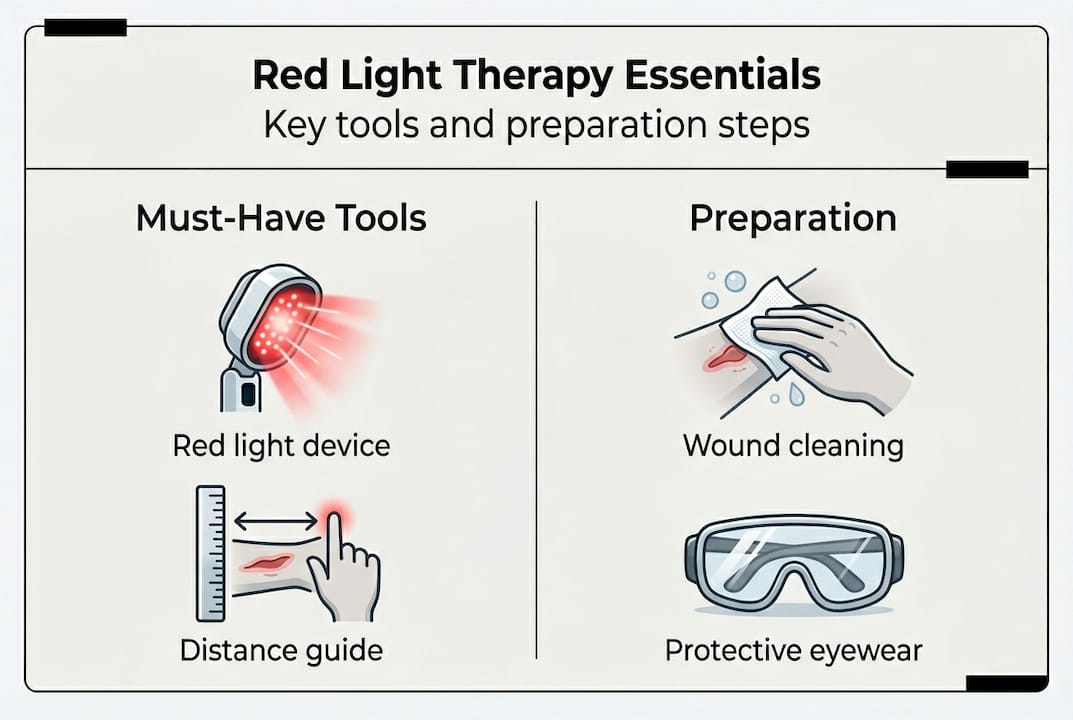
Before applying therapy, prepare the wound using standard care protocols. Clean the area with saline or prescribed antiseptic, remove any loose debris, and pat dry gently. Apply red light therapy before redressing the wound, not through bandages or ointments that block light penetration. Position the device so light hits the wound bed directly, not at an angle that scatters photons away from target tissue.
Pro Tip: Use a ruler or tape measure to mark the exact distance from device to skin, ensuring consistent dosing across sessions. Small distance changes dramatically alter irradiance due to inverse square law physics.
Accessories improve accuracy and safety. Distance guides or adjustable stands maintain consistent spacing between device and wound. Timers prevent accidental overdosing when you’re distracted. Protective eyewear blocks stray light if treating facial wounds near eyes. A treatment log or smartphone app helps track session parameters, wound measurements, and healing milestones.
| Feature | Panel devices | Handheld devices |
|---|---|---|
| Coverage area | Large, treats multiple wounds simultaneously | Small, requires repositioning for coverage |
| Power consistency | Stable output across entire panel | Varies by distance and angle during use |
| Portability | Stationary, requires dedicated space | Compact, easy to travel with |
| Cost range | $200-$800 for quality units | $80-$300 for verified models |
Nutritional support amplifies red light therapy results by providing raw materials for tissue repair. Collagen peptides supply amino acids for extracellular matrix formation. Vitamin C acts as a cofactor for collagen hydroxylation, the biochemical step that stabilizes new tissue. Zinc supports immune function and epithelial growth. Combining therapy with 10-20 grams daily collagen, 500-1000 mg vitamin C, and 15-30 mg zinc creates synergistic healing acceleration that neither intervention achieves alone.
Browse red light therapy devices that meet clinical specifications, and consider measurement devices to verify your equipment delivers advertised power levels before starting treatment protocols.
Precise technique matters more than expensive equipment when applying red light therapy. Follow these steps to deliver effective doses without guesswork or trial-and-error experimentation.
Calculate target dose: Multiply your device’s irradiance by treatment time to determine energy dose. A device delivering 60 mW/cm² for 3 minutes provides 10.8 J/cm² (60 mW/cm² × 180 seconds ÷ 1000). Start with 2-4 J/cm² for initial sessions, gradually increasing to 6-10 J/cm² as tolerance develops.
Position device correctly: Place the light source 6-12 inches from the wound surface. Closer distances increase irradiance but reduce coverage area. Farther distances spread light over more tissue but decrease intensity. Measure and mark your chosen distance to maintain consistency across all sessions.
Set treatment duration: For a device with 50 mW/cm² irradiance targeting 5 J/cm², treat for 100 seconds (5000 mJ ÷ 50 mW = 100 seconds). Round to the nearest 30-second increment for practical timing. Most wounds respond well to 2-5 minute sessions depending on device power and target dose.
Apply therapy consistently: Treat once daily for minor wounds or twice daily (morning and evening) for chronic or severe injuries. Space sessions at least 6 hours apart to allow cellular responses to complete before the next stimulation. Monitor response and reduce dose if you see no improvement after one week, as excessive dosing can inhibit rather than accelerate healing.
Document each session: Record date, time, device distance, treatment duration, and any observations about wound appearance or symptoms. This log helps identify patterns and guides adjustments if healing plateaus.
Pro Tip: Treat immediately after cleaning and before applying new dressings. Photons penetrate clean tissue far more effectively than through ointments, creams, or bandage materials that scatter and absorb light energy.
Frequency and consistency produce better results than sporadic high-intensity sessions. A wound treated with 5 J/cm² daily for two weeks receives more cumulative benefit than the same wound treated with 10 J/cm² three times weekly. Cellular repair mechanisms respond to regular stimulation patterns, not occasional intense doses.
Adjust protocols based on wound characteristics. Shallow abrasions heal faster and may only need 7-10 days of therapy. Deep surgical incisions or diabetic ulcers require 3-6 weeks of consistent treatment. Infected wounds need antibiotic therapy first; red light therapy accelerates healing only after infection is controlled.
For detailed protocols on facial applications that translate to wound care, review red light therapy masks protocols, and explore portable red light therapy devices for treating wounds in hard-to-reach locations.
Even experienced users make dosing errors that compromise results. Avoid these pitfalls to maximize healing acceleration and prevent setbacks.
Overdosing above 10 J/cm²: Excessive energy inhibits fibroblast activity and collagen deposition through a phenomenon called biphasic dose response. More light does not equal faster healing. If you exceed 10 J/cm² per session, reduce treatment time or increase device distance to lower irradiance.
Skipping standard wound care: Red light therapy enhances healing but cannot sterilize infected tissue or replace surgical debridement. Always clean wounds, remove necrotic material, and follow medical instructions before applying light therapy.
Using unverified devices: Many consumer products claim therapeutic power but deliver less than 20 mW/cm², making effective dosing impossible within practical timeframes. Devices without published irradiance specifications or independent testing often waste your money and time.
Treating through barriers: Ointments, hydrocolloid dressings, and clothing block photon penetration. Remove all barriers before therapy, then reapply dressings after the session ends.
Ignoring skin reactions: Mild warmth during treatment is normal, but persistent redness, increased pain, or irritation signals excessive dosing. Take a 48-hour break and resume at 50% of your previous dose.
Some clinical trials show inconsistent results due to dosing heterogeneity across studies. Researchers use vastly different wavelengths, power densities, and treatment schedules, making direct comparisons difficult. This variability means you must track your individual response rather than expecting universal outcomes.
“The challenge with red light therapy research is protocol standardization. What works in one lab at 5 J/cm² may fail in another using 15 J/cm² due to biphasic effects. Home users need to start conservatively and adjust based on their wound’s specific response patterns.”
If healing stalls after initial progress, reassess your protocol. You may need to increase dose slightly if starting too low, or decrease if inadvertently overdosing. Wound healing is not linear; expect periods of rapid improvement followed by slower consolidation phases. Patience and consistent tracking reveal whether therapy is working or needs adjustment.
Complement light therapy with evidence-based recovery tools that support systemic healing, and consider exploring infrared light therapy panel options for larger treatment areas requiring simultaneous coverage.
Objective tracking separates effective protocols from wasted effort. Use these methods to quantify healing and make data-driven adjustments.
Photographic documentation provides visual proof of progress. Take photos weekly under consistent lighting conditions, using the same camera angle and distance. Place a ruler or coin next to the wound for scale reference. Compare images side by side to spot subtle changes in wound bed color, edge epithelialization, and granulation tissue formation that daily observation might miss.
Measure wound dimensions using the length-times-width method. Identify the longest axis of the wound and measure in millimeters. Rotate 90 degrees and measure the widest perpendicular axis. Multiply these values to calculate wound area in square millimeters. A wound measuring 15 mm × 10 mm has an area of 150 mm². Track this number weekly; consistent reduction indicates effective healing.
| Metric | Week 1-2 | Week 3-4 | Week 5-6 |
|---|---|---|---|
| Wound area reduction | 10-20% decrease | 30-50% decrease | 60-80% decrease |
| Pain level (0-10 scale) | Slight reduction | Moderate reduction | Minimal or absent |
| Exudate amount | May increase initially | Decreasing steadily | Minimal or dry |
| Granulation tissue | Beginning to form | Filling wound bed | Complete coverage |
Track subjective symptoms alongside objective measurements. Rate pain on a 0-10 scale before each session. Note changes in swelling, redness, warmth, or drainage. Improved symptoms combined with shrinking wound size confirm therapy effectiveness. Worsening symptoms despite size reduction may indicate infection requiring medical evaluation.
Biohackers should track healing metrics such as photos and wound area measurement for synergy with nutrition interventions. Combining objective data from light therapy with dietary optimization creates a complete picture of which variables drive your healing rate.
Compare your progress against expected healing timelines. Acute wounds typically close within 2-3 weeks with therapy, versus 3-4 weeks without intervention. Chronic wounds show measurable improvement within 2 weeks if therapy will succeed; lack of any progress by day 14 suggests protocol adjustment or medical consultation.
Adjust treatment parameters if healing plateaus. Increase dose by 20-30% if progress stops but no adverse reactions occurred. Decrease dose by 30-50% if you developed irritation or if initial rapid healing suddenly reversed. Some wounds require a maintenance phase at lower doses after initial closure to prevent recurrence.
For additional insights on tracking healing metrics and adjusting protocols, explore healing progress tracking methods that translate facial therapy principles to wound care applications.
Optimizing wound healing requires equipment that delivers verified wavelengths and power levels consistently. Browse the red light therapy devices collection to find panels and handhelds with published specifications that meet clinical dosing requirements. Panel devices provide broad coverage for multiple wounds or large treatment areas, while portable options offer flexibility for targeted therapy on specific injuries.
The Shape Tactics advanced low-level light therapy device combines therapeutic wavelengths with ergonomic design for precise wound treatment. Complement your light therapy protocol with evidence-based recovery tools collection that support systemic healing through circulation enhancement, inflammation management, and tissue regeneration. Combining modalities creates synergistic effects that accelerate recovery beyond what any single intervention achieves alone.
Surgical incisions, diabetic ulcers, pressure sores, and minor burns show the strongest evidence for accelerated healing with red light therapy. Superficial wounds with intact blood supply respond faster than deep or ischemic injuries. Infected wounds require antibiotic treatment first, then benefit from light therapy during the repair phase.
No, treat infections with appropriate antibiotics or antiseptics before starting light therapy. Red light stimulates cellular activity but does not kill bacteria or sterilize tissue. Apply therapy only after infection is controlled to avoid spreading pathogens or delaying necessary medical treatment.
Most users notice reduced pain and inflammation within 3-5 days of consistent treatment. Visible wound size reduction typically appears by day 7-10. Complete closure depends on wound severity but generally occurs 30-50% faster than without therapy, turning a 4-week healing timeline into 2-3 weeks.
Yes, when following proper dosing protocols and device specifications. Red and near-infrared light at therapeutic intensities do not damage healthy tissue or cause burns. Avoid direct eye exposure during facial treatments and discontinue use if you develop persistent irritation or unexpected reactions.
No, red light therapy complements standard wound care but never replaces it. Continue cleaning wounds, changing dressings, and following medical advice while adding light therapy as an enhancement. Severe wounds, signs of infection, or lack of healing progress within two weeks require professional medical evaluation regardless of therapy use.


