

Mon-Fri 9am-6pm PST
+1 (800) 686-5898
support@longevitybased.com
Mon-Fri: 9am-6pm PST

While there are numerous options available to individuals interested in reducing their biological age — some supported by credible science, others not so much — determining which of those alternatives will yield the most effective results for a particular individual can be confusing.
You're looking for real-world results, and not simply empty claims or reckless experimentation. This guide will cut through the noise to provide evidence-supported, anti-aging approaches and devices that actually slow down the aging process.
We'll outline foundational habits, effective supplementation, thermal therapies and ways to track your progress as well as what health-conscious adults and biohackers can expect from a reliable resource. At the end of this guide, you'll have a clear plan for optimizing your health span with confidence and precision.
| Points | Details |
|---|---|
| First Foundation First | Prioritize quality sleep (7-9 hours), 150 minutes of moderate-intensity exercise per week, and eat a Mediterranean-style diet with intermittent fasting prior to using devices or supplements. |
| NAD+ Optimization | Small human studies show NMN and NR raise NAD+ levels, with mixed results so far for metabolic health; human data is expanding rapidly. |
| Microbiome Matters | Early pilot data suggest supplements that target the microbiome may lower estimated biological age and systemic inflammation. |
| Thermal Therapies Work | Saunas and ice baths both cause hormetic stress responses that activate pathways associated with longevity and resilience. |
| Track and Verify | Wearables, biomarkers, and coronary artery calcium (CAC) scores are three methods to measure progress and avoid extreme, unproven biohacks. |
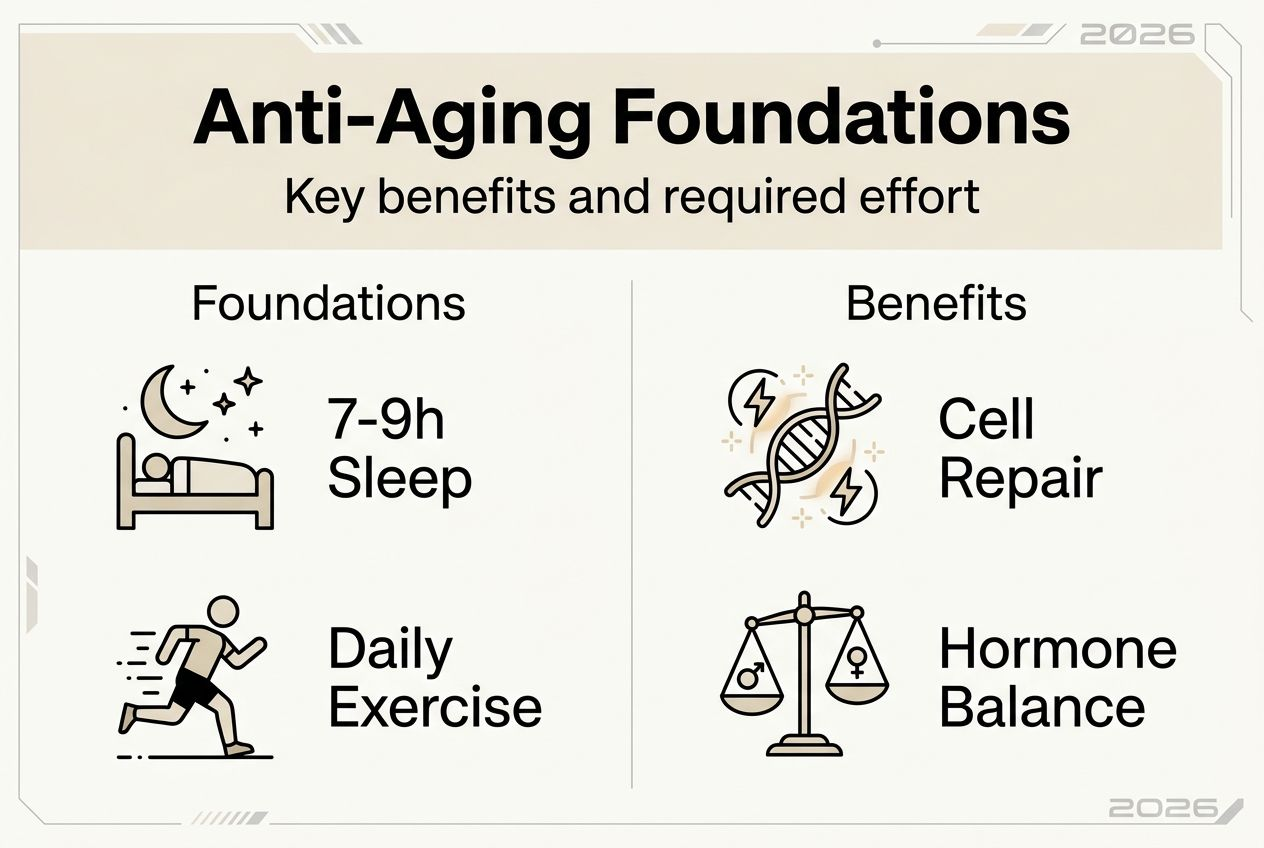
Establish a solid foundation before moving forward with supplements or devices. In order to get the best possible results out of your supplements and devices, you should establish your lifestyle foundation. Quality sleep of 7-9 hours, 150 minutes of moderate-intensity exercise per week (including zone 2 cardio and strength training), and a Mediterranean-style diet with 12-16 hours of intermittent fasting each day provide the foundation for effective anti-aging wellness. These habits are free, accessible, and supported by decades of research that show they reduce your risk of chronic diseases and increase your health span.
After establishing your lifestyle foundation, you will then begin to use tracking tools to help you determine which of your habits and interventions are providing you with the greatest amount of benefit. Wearables such as the Oura Ring monitor your sleep quality, heart rate variability, and your recovery. Continuous glucose monitors (CGMs) allow you to see how your body reacts to different types of foods and therefore help you optimize your metabolic health. Full-body scans and CAC scores allow you to detect early signs of cardiovascular aging before you experience any symptoms. These technologies give you the ability to make data-driven decisions instead of relying on assumptions.
Red light therapy (RLT) devices and NAD+ precursors such as NMN and NR are examples of additional science-backed interventions. Red light therapy increases mitochondrial function and collagen production, thereby promoting healthy skin and increased cellular energy. NAD+ precursors restore decreasing levels of this essential coenzyme that affects the way your body metabolizes food. Both have demonstrated benefits in human studies, and are good candidates for inclusion in your regimen after you have established your lifestyle foundation.
Below is a chart comparing foundational habits, devices and supplements:
| Category | Benefit | Effort Required |
|---|---|---|
| Sleep 7-9h | Cellular repair, hormone balance | Moderate (discipline required to schedule sleep) |
| Zone 2 cardio + strength | Cardiovascular health, muscle preservation | High (requires time commitment) |
| Mediterranean diet + IF | Metabolic health, inflammation reduction | Moderate (meal planning involved) |
| Wearables & CGMs | Real-time health data, personalized insight | Low (easy to set up) |
| Red Light Therapy | Mitochondrial function, skin health | Low (10-20 minute sessions) |
| NMN/NR supplements | NAD+ restoration, metabolic health | Low (taking a pill) |
Tip: Establish your lifestyle foundation for at least eight weeks before incorporating devices or supplements into your regimen. This will allow you to measure the effectiveness of your supplements and devices more accurately, and avoid wasting money on ineffective interventions.
The key is to build a foundation and layer additional interventions effectively. Sticking with exercise over months and years matters more than short bursts of high frequency or intensity when it comes to maximizing longevity benefits. Combining intermittent fasting with a nutrient-dense eating window may offer greater cumulative benefits than using either method alone. When you track your progress, you create the conditions where you can utilize additional interventions to produce measurable results.
You now know the importance of creating a solid foundation, and how to layer additional interventions. Now it's time to learn how to implement proven anti-aging strategies systematically. Follow the guidelines provided in this section to maximize your results while minimizing risk.
Optimize NAD+ levels with NMN or NR. Start with 250-500 mg of either NMN or NR per day. Small human trials have found that NMN supplementation improved muscle insulin sensitivity after 10 weeks and aerobic capacity after 6 weeks. Additionally, animal studies have shown even greater benefits to mitochondrial function and DNA repair. Take your NAD+ precursors in the morning to coincide with your body's natural circadian rhythm of NAD+.
Target the microbiome with supplements. Prebiotics are nutrients that promote growth of beneficial microorganisms in the gut. Postbiotics contain metabolic by-products produced by beneficial microbes that inhibit the growth of pathogens. Senolytics kill senescent cells that accumulate with age. A small 2025 pilot study (9 adults, no control group) reported that a microbiota-accessible nutritional complex lowered estimated biological age and the inflammation marker hs-CRP after 60 days. Start with a high-quality prebiotic and add postbiotics after four weeks to minimize gastrointestinal distress.
Practice intermittent fasting for 12-16 hours daily. Start with a 12-hour nighttime fast and expand to 14-16 hours as your body adapts. Fasting induces autophagy, a cellular cleanup process that eliminates damaged proteins and organelles. It also enhances insulin sensitivity and activates longevity-related pathways such as AMPK and sirtuins. Plan your eating window around your activity level for optimal results.
Utilize thermal therapies strategically. Thermal therapies include saunas and ice baths/cold showers. Heat shock proteins activated by sauna sessions protect cells from damage caused by oxidative stress. Cold shock proteins activated by ice baths and cold showers increase metabolic flexibility. Hormetic stressors such as heat and cold teach your body to adapt and become more resilient. Alternate between heat and cold for optimal benefit, but never exceed safe limits.
Perform consistent exercise that includes zone 2 cardio and strength training. Zone 2 cardio (you can still talk during the exercise) increases mitochondrial density and metabolic efficiency. Perform 120 minutes of zone 2 cardio per week. Include 30 minutes of strength training two times per week to maintain muscle mass and bone density. Monitor your heart rate zones with a wearable to ensure you are exercising at the correct intensity.
Before starting, prepare yourself:
Tip: Use wearable technology and quarterly biomarker testing to track your progress objectively. Your subjective feelings may mislead you, but data will tell you if your interventions are producing measurable results on biomarkers such as HRV, glucose stability, and inflammatory markers.
Pitfalls to avoid when biohacking:
As the quote above illustrates, the most successful biohackers view anti-aging as a long-term process, and as such, they tend to choose interventions with the strongest evidence and lowest risk. They also track their results carefully and modify their approach based on the data they collect, not because of marketing claims or anecdotal stories. As such, they produce long-lasting results that continue to grow over time and decades.
Applying proven anti-aging strategies is only half the battle. You must confirm that the strategies you are using are effective and prevent hazardous biohacks that can jeopardize your health. Tracking the right biomarkers is essential to distinguishing between actual improvement and a placebo response, as well as separating science-backed marketing claims from unsubstantiated claims.
Biomarkers to Monitor:
Track these biomarkers every 3-6 months to capture emerging trends. A single snapshot can mislead due to daily variations; however, tracking over time will indicate whether your interventions are moving you in the right direction.
Not all biohacks are created equally. The table below compares common interventions:
| Biohack | Benefit | Evidence Strength | Risk Profile |
|---|---|---|---|
| NMN/NR | NAD+ Restoration, Metabolic Health | Moderate (Growing human data) | Low (Well-tolerated) |
| Red Light Therapy | Mitochondrial Function, Skin Health | Moderate (Multiple RCTs) | Very Low (Non-invasive) |
| Intermittent Fasting | Autophagy, Insulin Sensitivity | Moderate (Human autophagy data limited) | Low (If done correctly) |
| Rapamycin | mTOR Inhibition, Lifespan Extension | Strong in animals; Limited in Humans | Moderate to High (Immune Suppression) |
| Metformin | Glucose Regulation, Potential Longevity | Moderate (Observational Studies) | Low (Well-studied medication) |
| Peptides | Variety (Depends on Type) | Weak to Moderate (Limited Regulation) | Moderate (Quality Concerns) |
Indicators That You Are Overreaching or Engaging in Unhealthy Biohacks:
"Many longevity interventions that are effective in mice, like rapamycin, pose serious risks to humans. Rapamycin suppresses the immune system, thus increasing the risk of infection even though it may prolong life. The risk/reward ratio is poor for most people, given that lifestyle interventions offer well-documented longevity benefits with little downside."
This quote exemplifies a fundamental truth: many extreme biohacks that have great potential promise more than they actually deliver, and introduce a significant number of potential hazards. There is little human longitudinal data to support most cutting-edge interventions, and you become an unwitting participant in an experiment. Conversely, lifestyle modifications offer well-documented longevity benefits with minimal risk.
Tip: Consult with a healthcare professional on a regular basis to interpret your data and alert you to problems early. A physician who specializes in longevity can assist you in navigating the gray area between proven interventions and experimental treatments and enable you to optimize your health span without risking your health.
Therefore, the most intelligent approach is to prioritize interventions with the greatest evidence base and lowest risk first. Develop a strong foundation in sleep, exercise, nutrition, and stress management before trying peptides or off-label medications. Utilizing biomarkers to track your progress allows you to evaluate your results objectively, rather than relying on how you feel. This cautious, data-driven approach will maximize your chance of achieving 90 with the vitality of someone decades younger.
Are you ready to apply the science? Longevity Based offers a hand-curated assortment of anti-aging devices and supplements that meet strict criteria for quality and efficacy to support your anti-aging wellness journey.
Red light therapy devices and NAD+ precursors are examples of evidence-backed anti-aging devices and supplements. Red light therapy devices stimulate mitochondrial function and collagen production, resulting in improved skin health and cellular energy. NAD+ precursors restore decreasing levels of this vital coenzyme that affects how your body processes food. Both have been studied in humans, and are reasonable additions to your regimen after you have established your lifestyle foundation.
All products offered are vetted for scientific backing and manufacturing quality. Therefore, you will not find gimmicks or unproven devices. Instead, you will find tools that align with the evidence-based approach described in this article. Browse the entire collection of biohacking devices and longevity products to find solutions that fit your unique objectives and budget.
Advantages of purchasing vetted anti-aging products:
No supplement has yet been proven to slow aging in humans, but NMN and NR are among the most studied. They increase levels of NAD+, a coenzyme essential for producing ATP (the cell's energy currency). Small human trials have reported improved muscle insulin sensitivity and aerobic capacity within six to ten weeks, although results across studies are mixed. Supplements such as NMN and NR are best used in combination with solid lifestyle practices (such as a good night's sleep, regular physical activity and a healthy diet) and should not be viewed as stand-alone interventions.
Red light therapy enhances the mitochondrial functions of cells through the application of specific wavelengths that support cellular energy production. Red light therapy also promotes collagen synthesis and supports the reduction of inflammation and the acceleration of tissue repair. Home-use devices allow you to easily integrate red light therapy into your daily routine, with treatments taking no longer than ten to twenty minutes per session.
Most extreme biohacks are based upon insufficient amounts of human data to evaluate their long-term safety. In particular, the promising findings regarding rapamycin in animal studies demonstrate the serious risks of immune suppression and increased risk of infections in humans. Therefore, focus on using proven lifestyle interventions and well studied supplements before attempting to implement unproven or experimental protocols. By understanding the risks associated with biohacking, you will be better equipped to make informed choices that balance the potential benefits of biohacking with its inherent risks.
You may notice some subjective benefits to your sleep and exercise habits within two to four weeks, however, you will not experience any objective changes in biomarkers until eight to twelve weeks. In small trials, NAD+ precursor supplementation has improved some metabolic markers within six to twelve weeks, although results are mixed. Using wearable technology and getting blood work every three months will help you track trends over time and avoid being misled by the fluctuation of day-to-day variations.


