

Mon-Fri 9am-6pm PST
+1 (800) 686-5898
support@longevitybased.com
Mon-Fri: 9am-6pm PST

TL;DR:
- Red light therapy is a non-invasive, low-risk treatment that may influence migraine-related biological pathways.
- Current evidence is promising but preliminary; larger, long-term studies are needed before clinical endorsement.
- RLT should be used as a complementary approach alongside established migraine treatments, with proper guidance and tracking.
Millions of people living with migraines are actively searching for relief beyond conventional medications, yet most neurologists rarely mention red light therapy (RLT) as an option. That gap between growing consumer interest and clinical silence is striking. RLT is trending across wellness communities, but separating genuine promise from marketing hype requires a clear look at the science. This article walks you through what RLT actually is, how it might interact with migraine biology, what published research shows, and how to use it safely if you decide to try it.
| Point | Details |
|---|---|
| Evidence is preliminary | Current research on red light therapy for migraines is promising but not conclusive. |
| Adjunct, not replacement | RLT should be used alongside proven migraine treatments, not as a stand-alone cure. |
| Consult your provider | Always involve a healthcare professional before starting red light therapy for migraines. |
| Track and reassess | Document your migraine patterns when trying RLT to evaluate your own results. |
Red light therapy is a non-invasive treatment that exposes the body to specific wavelengths of light, typically in the visible red and near-infrared spectrum. Unlike UV light, which damages skin, these wavelengths penetrate tissue without causing harm. The therapy is delivered through panels, handheld devices, light caps, and clinical-grade systems, making it accessible both in professional settings and at home.
The science of light therapy centers on a process called photobiomodulation (PBM), where light energy is absorbed by mitochondria, the energy-producing organelles in cells. This absorption stimulates ATP production, reduces oxidative stress, and modulates inflammatory signals. RLT typically uses wavelengths in the 600 to 900 nm range to stimulate these biological processes, with red light (600 to 700 nm) affecting surface tissue and near-infrared light (700 to 900 nm) reaching deeper structures including muscle and nerve tissue.
These biological effects are why RLT has found application across a wide range of conditions. Common uses include:
The reason RLT is now being considered for migraines relates to its potential influence on neurological pathways and systemic inflammation. Migraines are not simply headaches; they involve complex neurological events, including cortical spreading depression, trigeminal nerve activation, and neuroinflammation. Because RLT has demonstrated anti-inflammatory and neuroprotective effects in other contexts, researchers began asking whether those same mechanisms could translate to migraine relief. That question is now being tested in clinical settings, though the answers are still preliminary.
To understand RLT’s potential role in migraine management, it helps to know how migraines work at a biological level. Three major mechanisms are central to most migraine episodes:
RLT may interact with all three of these pathways. Photobiomodulation has been shown to reduce pro-inflammatory cytokines and modulate nitric oxide signaling, both of which are implicated in migraine onset. Near-infrared light, in particular, penetrates deep enough to reach cranial nerve tissue and cerebral vasculature, which is why some researchers believe it could influence the trigeminal system directly.

The distinction between infrared vs red light matters here. Red light targets more superficial tissue, while near-infrared wavelengths can reach deeper neural structures. For migraine applications, devices combining both spectrums may offer broader coverage of the relevant biological targets.
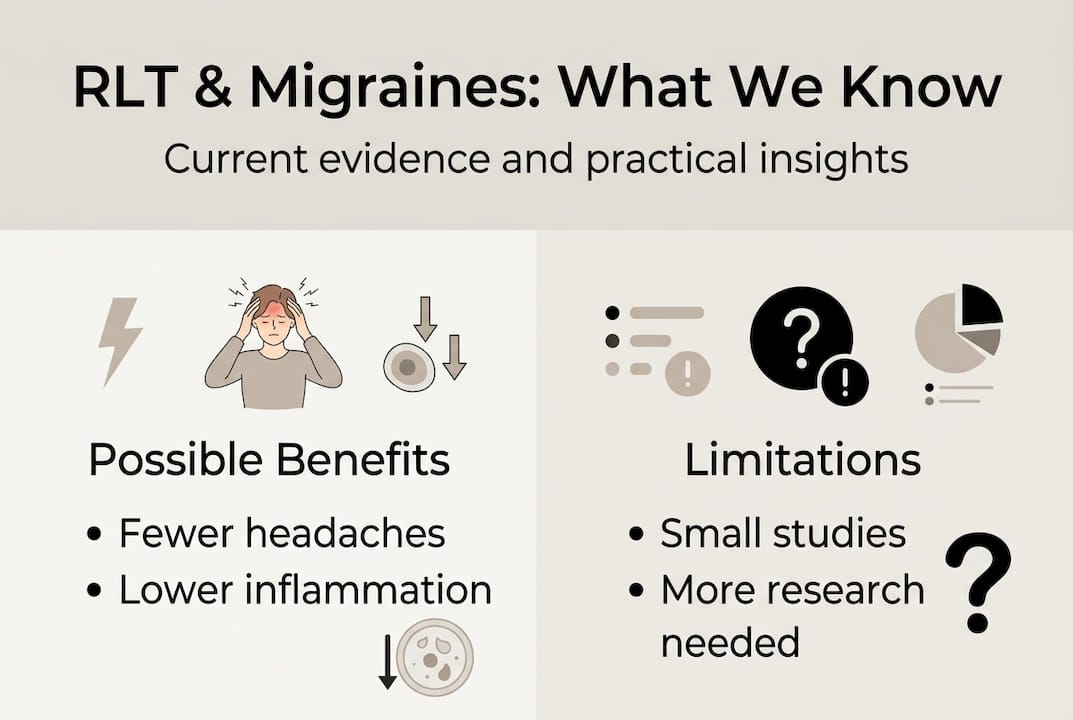
Animal studies have shown that PBM reduces pain behavior and inflammatory markers in models of neuropathic pain. Early human trials have reported reductions in migraine frequency and intensity with regular RLT use. However, these findings come with important caveats.
“Some RCTs indicate benefits, but evidence is preliminary and not yet guideline-endorsed.” — Frontiers in Neurology, 2025
This is a critical point. Promising early signals do not equal proven treatment. The biological rationale is sound, and the early data is encouraging, but robust, large-scale randomized controlled trials (RCTs) are still needed before RLT can be recommended as a standard migraine intervention.
Published research on RLT for migraines is growing but still limited in scope. Most available studies are small pilot trials with short follow-up periods. Here is a summary of what the data shows:
| Study type | Sample size | Key finding | Limitation |
|---|---|---|---|
| Pilot RCT (2023) | 40 participants | Reduced migraine days per month | Short duration, no control for placebo |
| Observational study | 60 participants | Lower pain intensity scores | Self-reported outcomes |
| Animal model (PBM) | N/A | Reduced inflammatory markers | Not directly translatable to humans |
| Systematic review (2025) | Multiple trials | Mixed but trending positive | Heterogeneous protocols |
The pattern is consistent: current evidence is promising but preliminary, and larger, long-term RCTs are needed before firm conclusions can be drawn. No major neurology guideline currently endorses RLT as a first-line or adjunct migraine therapy, which is a meaningful distinction for anyone weighing their options.
Crowd-reported outcomes from wellness communities are more enthusiastic, with many users reporting fewer attacks and shorter recovery times. These reports are valuable as signals, but they are not a substitute for controlled clinical data. Placebo effects in pain research are well-documented and can be substantial.
The RCT evidence from Frontiers in Neurology reinforces that the field is moving in a positive direction, but patience is warranted. Understanding how often to use red light is also relevant here, since inconsistent dosing across studies makes it difficult to compare results.
Pro Tip: Before starting RLT for migraines, consult a neurologist or headache specialist. Chronic migraine sufferers in particular may have underlying conditions that require medical supervision alongside any new therapy.
If you’ve reviewed the evidence and want to try RLT as a complementary strategy, a structured approach improves both safety and the likelihood of meaningful results. Best used as an adjunct to other approaches with a provider’s guidance, RLT should fit into a broader migraine management plan rather than replace it.
Here is a practical step-by-step framework:
Complementary therapies that can safely pair with RLT include magnesium supplementation, cognitive behavioral therapy for chronic pain, biofeedback, and acupuncture. These approaches share a low-risk profile and may work synergistically with RLT’s anti-inflammatory effects.
Pro Tip: Keep a migraine diary for at least four weeks before starting RLT. This baseline data gives you an objective comparison point so you can assess whether the therapy is genuinely making a difference.
Placing RLT in context alongside other migraine therapies helps set realistic expectations. No single treatment works for everyone, and the most effective migraine management plans typically combine multiple strategies.
| Treatment | Evidence level | Side effects | Cost | Accessibility |
|---|---|---|---|---|
| Triptans (medication) | High (guideline-endorsed) | Cardiovascular risk, rebound headache | Moderate | Prescription required |
| CGRP inhibitors | High (newer standard) | Injection site reactions | High | Specialist-prescribed |
| Acupuncture | Moderate | Minimal | Moderate | Widely available |
| Biofeedback | Moderate | None | Moderate | Requires training |
| Red light therapy | Low to moderate (preliminary) | Minimal | Low to moderate | Over-the-counter devices |
| Magnesium supplementation | Moderate | GI discomfort at high doses | Low | OTC |
RLT’s strongest advantage is its low risk profile. Unlike triptans or CGRP inhibitors, it carries no cardiovascular contraindications and no rebound headache risk. Its evidence base is weaker, but for people who cannot tolerate medications or want a drug-free option, that tradeoff may be worth exploring.
RLT should be an adjunct, not a replacement for proven migraine strategies. Think of it as one tool in a broader toolkit that includes:
Combining low-risk complementary approaches with established treatments often produces better outcomes than relying on any single intervention.
We follow the research on photobiomodulation closely, and our honest read is this: RLT is not a cure for migraines, and it should not be positioned as one. The biological mechanisms are credible, the early data is encouraging, and the risk profile is genuinely low. Those are meaningful positives.
What concerns us is the tendency in wellness spaces to leap from “promising early signal” to “proven treatment.” That leap does a disservice to people who are suffering and deserve accurate information. Chasing unproven miracle cures often delays access to therapies that actually work.
For chronic migraine sufferers in particular, RLT may offer modest, cumulative benefits when integrated into a whole-person care plan. The key words are integrated and documented. Use it alongside established care, track your outcomes rigorously, and stay informed as the research matures. The comparison between RLT vs. infrared options is also worth understanding before investing in a device, since wavelength selection matters for neurological applications.
Realistic expectations and methodical self-tracking are what separate productive experimentation from wishful thinking.
If you’re ready to explore RLT as part of your migraine wellness strategy, starting with the right device matters. At Longevity Based, we offer a curated range of red light therapy devices built to clinical-grade specifications, with clear wavelength data and evidence-backed design. For a portable, targeted option, the BioLight Glow is a well-regarded choice for home use. Our blog also provides ongoing guidance on protocols, device selection, and integrating light therapy into a broader health plan. Explore our resources to make an informed, confident decision before you begin.
Current evidence is preliminary and does not support RLT as an acute intervention that stops a migraine in progress. Most protocols focus on reducing frequency over time with consistent use rather than providing immediate relief during an attack.
Based on small, short-term studies, several weeks of regular use may be needed before noticing measurable changes in migraine patterns. Four to six weeks of consistent sessions is a reasonable minimum timeframe for initial assessment.
RLT is generally well tolerated, but individuals with photosensitive conditions, those taking photosensitizing medications, or those who are pregnant should consult a provider before starting. Eye protection is essential during any cranial application.
No. Never discontinue prescribed medications without medical guidance. RLT is intended to supplement, not replace proven migraine treatments, and combining it with your existing care plan is both safer and more likely to produce results.


