

Mon-Fri 9am-6pm PST
+1 (800) 686-5898
support@longevitybased.com
Mon-Fri: 9am-6pm PST

TL;DR:
- Proper hydration, gradual adaptation, and body signals are crucial for safe sauna use.
- Optimal session duration is 15 to 20 minutes, with frequency driving health benefits.
- Overextending beyond 30 minutes offers minimal gains and increases risks.
Stepping into a dry sauna without a clear plan is more common than most enthusiasts admit. You set a mental timer, start sweating, and wonder: is five more minutes going to push your cardiovascular adaptation, or push you into heat stress? The answer matters. Too short, and you leave real physiological benefits on the table. Too long, and you risk dehydration, dizziness, or worse. The good news is that research gives us precise, evidence-backed answers for every experience level, from first-timers to biohackers running multi-round contrast protocols. This guide covers everything you need to know: how to prepare, exactly how long to stay, and how to advance your practice safely.
| Point | Details |
|---|---|
| Start with shorter sessions | If new to dry saunas, begin with 5-10 minutes to safely build up tolerance. |
| Aim for 15-20 minutes | Most health benefits, including cardiovascular improvement, occur with 15-20 minute sessions. |
| Never exceed 30 minutes | Staying longer may increase health risks without added benefits. |
| Hydration and cool-down are crucial | Drink water before and after, and always include a gradual cool-down after your session. |
| Customization is key | Adjust sauna time based on your body’s signals, goals, and experience level. |
Before you think about duration, preparation determines whether your session is productive or counterproductive. Using saunas safely starts well before you open the sauna door.
Hydration is non-negotiable. Follow sauna safety guidelines and drink 16 to 24 ounces of water before your session and again after. Dry saunas typically run between 160°F and 200°F, and your body can lose a significant amount of fluid through sweat in just 15 minutes. Entering already dehydrated compounds that risk immediately.
What to bring and wear:
Check your health status first. Anyone with cardiovascular conditions, low blood pressure, or who is pregnant should consult a physician before using a dry sauna. The heat load is real and measurable.
Starting times by experience level:
| Experience level | Recommended start time | Temperature range |
|---|---|---|
| First-timer | 5 to 10 minutes | 150°F to 170°F |
| Occasional user | 10 to 15 minutes | 160°F to 180°F |
| Regular user | 15 to 20 minutes | 170°F to 195°F |
| Advanced/biohacker | 20 to 30 minutes | 175°F to 200°F |
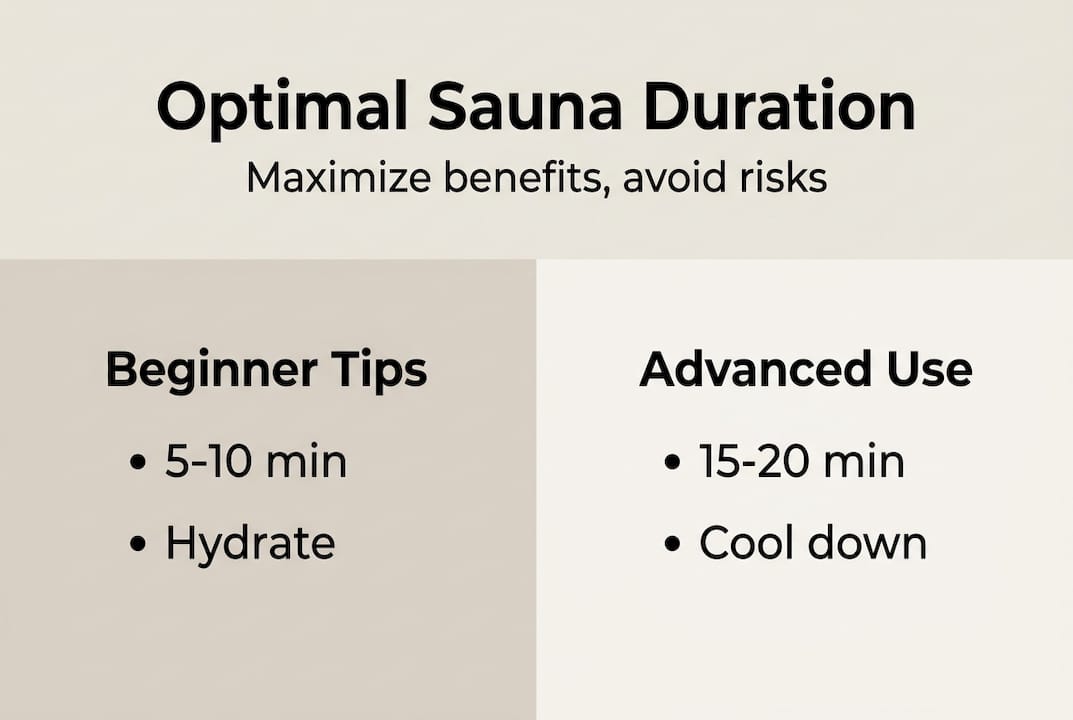
Beginners should start with 5 to 10 minutes to acclimate and avoid risks like dehydration or overheating. This is not a limitation; it is a foundation. Your body’s thermoregulatory system needs time to adapt before longer exposures become safe and beneficial.
Body signals override the clock every time. Dizziness, nausea, or a sudden feeling of weakness are your cues to exit immediately, cool down gradually, and rehydrate. Never push through these signals in pursuit of a time target.
Pro Tip: Cool down gradually after every session. Moving from extreme heat to cold air too quickly can cause blood pressure fluctuations. Spend two to three minutes in a neutral-temperature space before a cold shower or plunge.
With your preparation locked in, here is the practical breakdown of session duration by user type, built on current research and real-world protocols.
Critical safety note: Exit the sauna immediately if you feel dizzy, nauseous, or disoriented. No time target is worth overriding these signals.
Thinking about sauna frequency alongside duration is equally important. A 20-minute session four times a week outperforms a single 30-minute session every two weeks by a wide margin.
Why 30 minutes is the hard ceiling: Exceeding 30 minutes produces diminishing returns at best and heat stress or dangerous dehydration at worst. The physiological adaptations you are chasing, including heat shock protein (HSP) activation and cardiovascular conditioning, are largely complete within this window. More time does not equal more benefit.
Pro Tip: Pair sauna sessions with your workout schedule strategically. Research on sauna and exercise shows that post-workout sauna use amplifies growth hormone release and accelerates muscle recovery compared to sauna use alone.
Quick reference by expert duration benchmarks:
| Goal | Duration | Frequency |
|---|---|---|
| Acclimation | 5 to 10 min | 2 to 3x/week |
| General wellness | 15 to 20 min | 3 to 4x/week |
| Cardiovascular/longevity | 20 to 30 min | 4 to 7x/week |
Understanding what happens inside your body during a timed session makes the duration recommendations far more meaningful.
When you enter a dry sauna, your core temperature begins to rise within minutes. Your cardiovascular system responds by increasing heart rate and dilating blood vessels, a load comparable to moderate-intensity exercise. Simultaneously, your body ramps up heat shock protein production, releases growth hormone, and initiates sweating for thermoregulation. These are the mechanisms behind the recovery and longevity benefits you are targeting.
Key physiological responses during a sauna session:
The landmark Finnish research from Dr. Jari Laukkanen provides some of the most compelling data available. 4 to 7 sessions per week at approximately 79°C (174°F) for around 20 minutes reduced cardiovascular disease mortality by 50% and sudden cardiac death by 63% compared to once-weekly use. These are not modest numbers.
For sauna recovery benefits, the 15 to 20-minute window is particularly effective post-exercise. Muscle soreness markers decrease, and anabolic hormone profiles improve when sauna use follows strength or endurance training. The broader sauna health benefits also include improved insulin sensitivity and reduced systemic inflammation with consistent use.

Benefits do plateau. After 30 minutes of continuous heat exposure, the incremental gains from additional time become negligible while risks continue to climb. This is why the research consistently points to 15 to 20 minutes as the optimal single-session target for most users.
If you have built a solid baseline of sauna tolerance, structured protocols can take your results further without simply adding more time.
Advanced multi-round protocol:
Multiple rounds of heat and cold cycling, such as 15 minutes of heat followed by a cold plunge repeated two to three times, enhance HSP activation and have been shown to improve mood through norepinephrine and dopamine modulation. This is contrast therapy at its most structured.
Common mistakes advanced users make:
Pro Tip: For recovery-focused protocols, prioritize post-workout sauna use. For longevity and cardiovascular adaptation, consistency across the week matters more than any single session’s duration. Pair your exercise and sauna benefits strategically based on your weekly training load.
Choosing your protocol:
Know when to scale back. Persistent fatigue, disrupted sleep, or elevated resting heart rate are signals that your total heat load is too high for your current recovery capacity.
There is a consistent pattern among new sauna users: once they learn that longer sessions correlate with greater cardiovascular benefits, they immediately try to maximize time in the heat. It is an understandable instinct, but it misreads the research.
The Finnish studies that produced those remarkable mortality reduction figures were built on consistent, moderate-duration sessions, not marathon heat exposure. The participants were not pushing 45-minute sessions. They were showing up regularly for 20 minutes. Consistency is the variable that drives adaptation, not raw duration.
From a biohacking perspective, more is rarely better when you are working with hormetic stressors. The goal is to apply enough stress to trigger adaptation, then recover fully. Overextending sessions increases cortisol load, disrupts sleep quality, and can actually blunt the cardiovascular and hormonal responses you are trying to cultivate.
The smarter definition of “more” in sauna practice is more frequent sessions, smarter protocols, and better recovery tools, not longer time in the heat. Reviewing optimal sauna routines will show you that the most effective practitioners prioritize regularity and recovery quality over pushing duration limits.
A well-timed dry sauna session is one piece of a broader recovery and longevity strategy. At Longevity Based, you will find a curated range of biohacking devices designed to complement and amplify what your sauna practice starts. Red light and near-infrared therapy panels support cellular recovery between sessions, while cold therapy equipment makes contrast protocols more accessible and effective at home. Browse our full range of recovery tools to find what fits your protocol, and explore our cold therapy essentials for structured contrast therapy setups. Every product is selected to support evidence-based, sustainable health optimization.
Healthy, acclimated users can safely reach 30 minutes, but most measurable benefits are achieved by 20 minutes. Exceeding 30 minutes raises risk of dehydration and heat stress without meaningful additional benefit.
Research supports 4 to 7 sessions per week at around 20 minutes each to achieve the cardiovascular mortality reductions documented in Finnish population studies. Frequency matters as much as duration.
Exit immediately if you experience dizziness, nausea, or sudden weakness. Body signals override the clock, and no session target justifies ignoring these warning signs.
Yes, and the combination often produces better results than sauna alone. Pairing heat with cold in contrast therapy cycles enhances HSP activation and mood regulation, while red light therapy supports cellular recovery between sessions.


