

Mon-Fri 9am-6pm PST
+1 (800) 686-5898
support@longevitybased.com
Mon-Fri: 9am-6pm PST

At-home microneedling has exploded in popularity, with millions of people rolling tiny needles across their faces in hopes of turning back the clock. The promise sounds compelling: stimulate collagen, smooth wrinkles, and glow like you just walked out of a dermatologist’s office. But here’s the reality check. At-home devices use needles just 0.25 to 0.5mm deep, barely scratching the surface compared to professional tools. Before you invest in a dermaroller or microneedling pen, you need to understand exactly what these devices can and cannot do.
| Point | Details |
|---|---|
| Home vs professional effectiveness | At-home microneedling is best for maintenance and superficial skin improvements, while professional treatments provide more dramatic anti-aging results. |
| Safety is essential | Proper hygiene, needle length, and avoiding contraindicated conditions are critical to safe home microneedling. |
| FDA clearance distinction | Only professional microneedling devices are FDA-cleared; at-home devices are cosmetic tools with limited clinical backing. |
| Evidence for collagen induction | Clinical studies support collagen stimulation for professional microneedling but do not confirm significant collagen induction with home devices. |
Microneedling is a technique that uses a device covered in tiny needles to create controlled micro-injuries in the skin. Your body responds to these micro-injuries by triggering its natural repair process, which includes producing new collagen and elastin. That repair response is the whole point. The deeper the needle penetrates, the more significant the repair signal.
This is where at-home and professional treatments split sharply. Professional microneedling reaches the dermis for real collagen stimulation, while at-home devices only affect the superficial epidermis. Think of it like watering a plant: professional treatments reach the roots, while at-home tools only wet the surface. You can browse a range of microneedling devices to understand the spectrum of options available.
Here is a side-by-side breakdown of the two approaches:
| Feature | At-home microneedling | Professional microneedling |
|---|---|---|
| Needle depth | 0.25 to 0.5mm | 1.0 to 2.5mm |
| Skin layer reached | Epidermis | Dermis |
| Collagen stimulation | Minimal | Significant |
| FDA clearance | None (cosmetic use) | Yes, for wrinkles and scars |
| Primary benefit | Product absorption, mild texture | Wrinkle reduction, scar remodeling |
| Risk level | Low to moderate | Low (when performed by a professional) |
At-home microneedling device safety guidelines confirm that shallow needle depths are intentional for consumer use. The key benefits you can realistically expect from at-home tools include:
Understanding these limits is not a reason to dismiss at-home tools. It is a reason to use them correctly.
Let’s be direct: at-home microneedling will not erase deep wrinkles or significantly remodel your skin structure. What it can do is improve how your skin looks and feels on a surface level, and that is genuinely useful. Consistent use can give your skin a healthier, more radiant appearance over time.
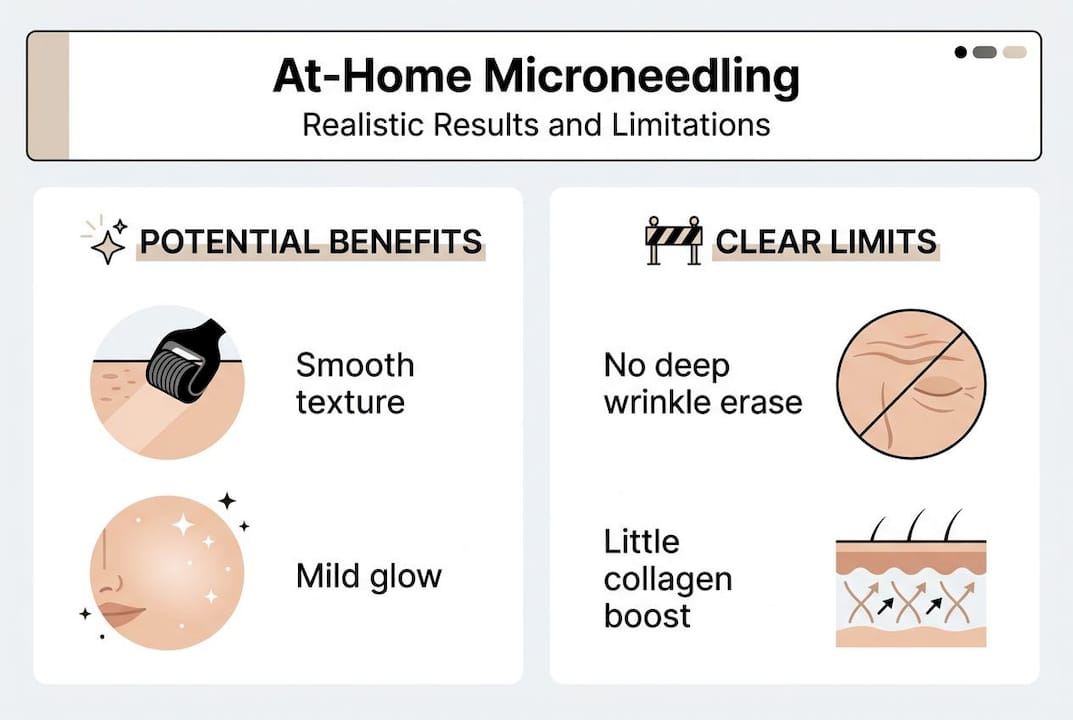
The honest picture on clinical evidence is sobering. Limited clinical evidence exists for anti-aging efficacy from at-home devices; most published studies focus on professional-grade treatments. This does not mean home devices are useless. It means their role is different from what marketing often suggests.
Here is what the research landscape actually looks like for microneedling outcomes:
| Outcome | At-home device | Professional treatment |
|---|---|---|
| Skin radiance | Mild improvement | Moderate to significant |
| Fine lines | Minimal effect | Visible reduction |
| Acne scars | Little to no effect | Clinically documented improvement |
| Pore appearance | Slight refinement | Noticeable improvement |
| Product absorption | Significant boost | Significant boost |
The smartest way to use at-home microneedling is as a support tool, not a standalone anti-aging solution. Pair it with evidence-backed actives like vitamin C, hyaluronic acid, or peptides to maximize the absorption benefit. For a broader view of what actually moves the needle on skin aging, the anti-aging wellness guide covers the full picture.
“At-home microneedling is best understood as a delivery system for your skincare products, not a collagen-building treatment in its own right.”
For those serious about visible rejuvenation, exploring skin rejuvenation strategies that combine multiple modalities will produce far better outcomes than relying on a dermaroller alone.
Pro Tip: Apply a hyaluronic acid serum immediately after at-home microneedling while the micro-channels are still open. Absorption rates are significantly higher in this window, making your existing products work harder.
At-home microneedling is not inherently dangerous, but it becomes risky fast when people skip the basics. The most common problems come from poor hygiene, using the wrong needle length, or treating skin that should not be treated at all. Knowing the risks upfront is what separates smart users from those who end up with worse skin than when they started.
Sticking to needle lengths of 0.5mm or less is the usual advice for home use, and the risk of infection, scarring, and post-inflammatory hyperpigmentation (PIH) rises sharply when hygiene or technique is poor. PIH is a darkening of the skin triggered by inflammation, and it is especially common in medium to deeper skin tones. It can take months to fade.
Here are the key contraindications and safety rules to follow:
For those interested in a more advanced home option, RF microneedling systems combine radiofrequency energy with microneedling for deeper tissue stimulation, though these require careful use. You can also explore a broader range of RF device options for skin tightening and rejuvenation.
Pro Tip: Never use a dermaroller on active breakouts. The rolling motion spreads bacteria across the skin and can turn one pimple into a cluster. A microneedling pen with a stamping motion is a safer choice if you have occasional blemishes in isolated areas.
Dermatologists consistently flag that poor technique dramatically increases risk with at-home tools. The device is only as safe as the person using it.
Choosing between at-home and professional microneedling is not really about budget alone. It is about what you are trying to achieve and how much risk you are comfortable managing yourself. Both have a legitimate place in a skincare routine, but they serve very different purposes.
The regulatory picture is clear. No FDA-cleared microneedling devices exist for at-home use; professional devices are cleared specifically for treating wrinkles and acne scars. This distinction matters because FDA clearance means a device has been tested for both safety and efficacy for a specific claim. At-home tools are sold as cosmetic devices, which means they are not held to the same standard.
Here is a direct comparison to help you decide:
| Factor | At-home | Professional |
|---|---|---|
| Cost per session | Low (one-time device cost) | $200 to $700+ per session |
| Needle depth | 0.25 to 0.5mm | 1.0 to 2.5mm |
| Collagen remodeling | Minimal | Significant |
| FDA clearance | No | Yes |
| Downtime | None to minimal | 1 to 3 days |
| Best for | Maintenance, absorption | Visible rejuvenation, scars |
If your goal is visible anti-aging results, professional treatment is the honest answer. If your goal is maintaining skin health, boosting product absorption, and supporting results between clinic visits, at-home microneedling earns its place. Here is how to approach the decision:
“Dermatologists consistently recommend professional microneedling for anyone seeking measurable rejuvenation. At-home tools are a complement, not a substitute.”
For those building a science-backed routine, evidence-based skincare resources can help you stack the right tools and actives for your specific goals.
If you are serious about skin health and anti-aging, the right tools make a measurable difference. At Longevity Based, we curate biohacking products specifically chosen for their scientific backing and real-world results. Whether you are looking to upgrade your microneedling setup or explore complementary modalities, our skin rejuvenation products cover everything from RF microneedling systems to recovery devices. For those interested in pairing microneedling with light therapy, our light therapy device supports cellular repair and skin recovery, making it an ideal post-treatment addition. Explore the full range and build a routine that goes beyond surface-level results.
At-home microneedling with shallow needles does not significantly stimulate collagen. Professional treatments with deeper needles are required to reach the dermis where real collagen remodeling occurs.
No. No at-home microneedling devices are FDA-cleared; only professional devices carry clearance for treating acne scars and wrinkles. At-home tools are classified as cosmetic devices.
The most common risks are irritation, infection, and post-inflammatory hyperpigmentation. Proper sterilization and technique are the two most important factors in keeping these risks low.
No. Microneedling is contraindicated for active acne and eczema because it can worsen inflammation and spread bacteria or irritants across the skin.
There is no single standard interval; many guides suggest waiting a few weeks between sessions, and the right spacing depends on needle length and your device's instructions. Consistent device sterilization and a gentle post-care routine are essential to avoid cumulative irritation.


