

Mon-Fri 9am-6pm PST
+1 (800) 686-5898
support@longevitybased.com
Mon-Fri: 9am-6pm PST

Most patients leave the operating room expecting a long, slow road to scar recovery. Creams, silicone sheets, and time are the standard prescription. But clinical research shows significant improvements in scar color and size with red light therapy, and one small study reported a treated scar healing in about half the time during early healing. If you are recovering from surgery or managing a visible scar, the science behind photobiomodulation offers a targeted, evidence-based path forward that most clinicians have yet to fully adopt.
| Point | Details |
|---|---|
| Rapid scar healing | Red light therapy can significantly speed up surgical scar recovery and improve appearance. |
| Best for recent scars | Recent scars respond best to treatment, while older scars may require adjunct therapies. |
| Safe and noninvasive | Red light therapy is safe for most people and rarely causes side effects. |
| Protocol matters | Using optimal wavelengths, energy dose, and session frequency is key for best results. |
| Adjunct therapy advised | Experts recommend combining red light therapy with other scar management techniques for maximum benefit. |
Red light therapy (RLT), also called photobiomodulation therapy (PBMT), uses specific wavelengths of light to stimulate biological processes at the cellular level. It is not heat-based and does not damage tissue. Instead, it works by delivering precise light energy that cells can absorb and convert into action.
The two primary wavelength ranges used are:
The primary mechanism involves light absorption by cytochrome c oxidase in the mitochondria, which increases ATP production, reduces reactive oxygen species (ROS), modulates inflammation, and regulates collagen synthesis. In plain terms, your cells get more energy to repair themselves, and the inflammatory response that slows healing is kept in check.
“Red light therapy uses red and NIR light to stimulate cellular processes in wound healing and scar reduction, with measurable improvements across multiple scar metrics.”
For surgical scars specifically, this means faster tissue remodeling, improved skin texture, and a reduction in the raised or discolored appearance that many patients find distressing. Understanding wound healing basics helps clarify why timing and wavelength selection matter so much in practice.
Understanding the mechanism leads us to real-world outcomes. What do clinical studies reveal about red light therapy on surgical scars?
A growing body of research confirms that RLT produces measurable improvements across the key metrics used to evaluate scar quality. One clinical study found that recent scars, those under six months old, responded best to treatment, with statistically significant improvements in color, size, and patient satisfaction.

A large meta-analysis of 56 RCTs involving 4,920 participants found a standardized mean difference (SMD) of 0.78 for wound healing improvement and 0.71 for pain reduction, both at p<0.01. These are clinically meaningful effect sizes, though researchers note that evidence certainty remains limited due to heterogeneity across studies.
Key improvements reported across trials:
Pre- and post-treatment scar metrics (illustrative example, not data from a specific study):
| Metric | Pre-treatment | Post-treatment | Change |
|---|---|---|---|
| Scar height (mm) | 2.4 | 1.1 | 54% reduction |
| Elasticity score | 3.1 | 5.8 | 87% improvement |
| Color normalization | Moderate deviation | Near-normal | Significant |
| Patient pain score | 6.2/10 | 2.9/10 | 53% reduction |
The data consistently points to one pattern: starting treatment early matters. Scars treated within the first six months show the strongest response. Adjusting red light session frequency based on scar age and severity is a key variable in achieving optimal outcomes.
With impressive data on clinical results, the next step is understanding how to maximize benefits through protocol standardization.
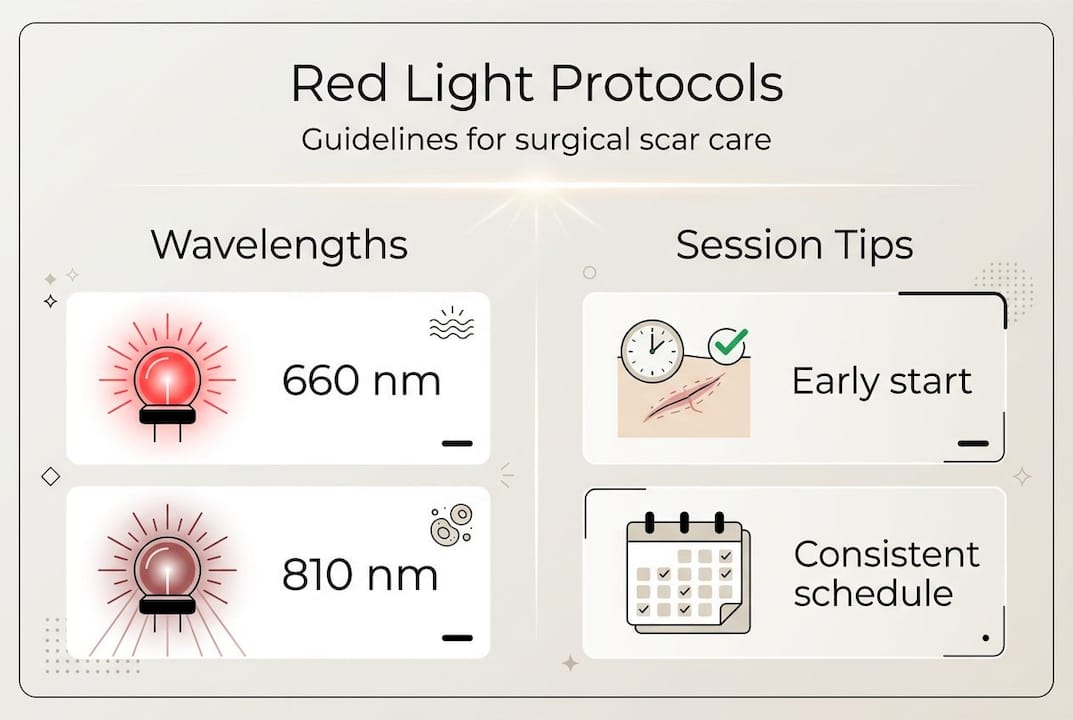
Not all red light devices or sessions are equal. The research points to specific parameters that produce the strongest outcomes for surgical scars. One clinical study used 660 nm red light at 5.6 J/cm², delivered over 6 minutes per session (for older and surgical scars), across 3 to 15 total sessions. Near-infrared wavelengths in the 700 to 850 nm range may help with deeper tissue remodeling.
Understanding the difference between infrared vs red light helps you select the right device for your scar type. Superficial scars respond well to red wavelengths alone, while deeper post-surgical tissue benefits from combined red and NIR protocols. You can also explore near-infrared therapy basics to understand how deeper wavelengths interact with tissue.
Step-by-step treatment schedule:
Non-contact vs. direct contact methods:
| Method | Best for | Notes |
|---|---|---|
| Non-contact (panel/device held above skin) | Larger scar areas, sensitive skin | Consistent dosing, easier to use |
| Direct contact (device placed on skin) | Targeted, localized scars | Higher energy delivery, requires clean skin |
For safe treatment tips and application guidance, reviewing evidence-based protocols before starting is always recommended.
Pro Tip: Starting treatment within the first three months post-surgery gives you the best window for tissue remodeling. Older scars are not unresponsive, but they typically require more sessions and may benefit from combining RLT with silicone gel or massage therapy.
Optimal treatment brings us to an equally important consideration: safety and who can benefit most from red light therapy for surgical scars.
Red light therapy has a strong safety record in clinical settings. Few adverse effects have been reported in published trials, and the most common reactions are mild and transient. Most users tolerate sessions without any discomfort.
Possible side effects (generally mild and short-lived):
Groups that should exercise caution:
For wound healing safety guidance, reviewing contraindications before beginning any home protocol is a practical first step.
Pro Tip: Always protect your eyes during sessions, even with devices marketed as safe for facial use. Direct exposure to concentrated light sources carries cumulative risk. If your scar is near the eye area, use appropriate protective eyewear.
After safety, it is wise to consider the limits and ongoing debates around red light therapy for scars, along with how it can fit into a broader scar management plan.
The evidence base for RLT in surgical scar treatment is genuinely promising, but it is not without gaps. Experts describe the data as conflicting, so it makes sense to treat RLT as an adjunct therapy rather than a standalone solution, particularly given the inconsistent results seen across some randomized controlled trials (RCTs). The core issue is study heterogeneity: different devices, wavelengths, dosages, and patient populations make direct comparisons difficult.
“Preliminary data is promising, but inconsistent RCT results mean red light therapy is best positioned as a complement to established scar management strategies, not a replacement.”
What the field needs is larger, more standardized trials with consistent protocols. Until that evidence exists, clinicians and patients alike should approach RLT with calibrated expectations.
Complementary approaches that pair well with RLT:
For those exploring broader skin rejuvenation alongside scar treatment, understanding how mask therapy compares to panel-based devices can help you build a more complete protocol.
The early science is promising: red light therapy, applied with the right wavelengths and consistent protocol, offers a meaningful advantage in surgical scar recovery. Finding a reliable device that matches clinical parameters is the practical next step. At Longevity Based, you will find vetted options designed for home use, including the BioLight Glow portable device for targeted scar treatment and the Shape Tactics advanced LLLT device for broader tissue recovery. Browse the full BioLight red light collection to find a device that fits your protocol and recovery goals. Every product is selected for its alignment with evidence-based parameters.
Red light therapy is most effective for recent surgical scars under six months old; older scars respond less consistently and may require more sessions or combined treatments such as silicone gel or massage to see meaningful improvement.
Published studies report no serious adverse effects; you might notice mild redness or itching at the treatment site, but these reactions are transient and typically resolve within hours.
One clinical study used 3 to 15 sessions at 660 nm and 3.7 to 5.6 J/cm², with session count depending on scar age, depth, and individual response to treatment.
Red light therapy should be used cautiously on keloids since results are less predictable; deeper NIR wavelengths may offer some benefit for hypertrophic scars, but consulting a dermatologist before starting is advisable.
Red light therapy is considered safe for most post-surgical patients, with few, mostly mild, adverse effects reported in clinical trials; however, those with photosensitivity or complex scar presentations should consult their healthcare provider before beginning treatment.


