

Mon-Fri 9am-6pm PST
+1 (800) 686-5898
support@longevitybased.com
Mon-Fri: 9am-6pm PST

TL;DR: The best red light therapy panels for 2026 combine red (around 630 to 670 nm) and near-infrared (around 810 to 850 nm) light, deliver enough irradiance to hit a useful dose in 10 to 20 minutes, and cover the body area you actually want to treat. Our top overall pick is the EMR-Tek Firewave PRO red light panel for its output-to-footprint ratio and ultra-low EMF build. For whole-body sessions, the EMR-Tek Ultron system is the one to beat. For face and neck work, a targeted spot device beats a big panel every time.
Red light therapy is the use of visible red and near-infrared light to drive a cellular response called photobiomodulation. Light in that band is absorbed by cytochrome c oxidase in the mitochondria, which is associated with increased ATP production, altered cell signalling and reduced oxidative stress.
A panel is simply a dense array of LEDs that delivers that light across a large area at once. Red wavelengths stay shallow and act mostly on skin. Near-infrared penetrates further and is the wavelength people use for joints, muscle recovery and deeper tissue.
Dose is the part most buyers miss. Energy delivered equals irradiance multiplied by time, so a weaker panel held closer for longer can deliver the same joules as a stronger panel further away. Published clinical protocols for skin commonly land near 15 J/cm2 per session, two or three sessions per week.
We ranked devices on five criteria, weighted in this order: spectrum quality, usable irradiance at a realistic treatment distance, coverage area, build quality and EMF, then price per watt of delivered light.
Every device below is one we stock and ship, so specifications, inclusions and warranty terms are checked against the manufacturer documentation rather than copied from a marketplace listing. Prices move, so treat figures as indicative and confirm on the product page.

The Firewave PRO is the panel we recommend to most people because it hits the sweet spot between output and footprint. It runs both red and near-infrared, uses an ultra-low EMF design, and ships with protective eyewear, a hanging kit and a power cord, which means no surprise add-on costs. Listed at $549.99 at the time of writing, with a one-year warranty.
Best for: daily targeted sessions on face, shoulders, knees or lower back. Watch out for: it is a targeted-format panel, so whole-body coverage means repositioning or buying two.

The standard Firewave panel sits one step below the PRO in output and price while keeping the same spectrum and build philosophy. Owners consistently describe it as heavy, bright and strong enough that new users should start with short sessions.
Best for: first-time buyers who want a serious panel without clinic pricing. Watch out for: at close range it is genuinely intense, so follow the distance guidance.

The Inferno delivers a heavier near-infrared load, which is the band associated with joints, tendons and muscle recovery rather than surface skin changes. If your main goal is knees, hips or a stubborn shoulder, weight the spectrum toward NIR.
Best for: athletes, lifters and anyone chasing recovery rather than cosmetic results. Watch out for: near-infrared is largely invisible, so it feels like less is happening even when output is high.

The Firedragon panel scales the same engineering up to a bigger emitter surface, so you can treat a full back or front torso in a single session instead of two. It is the logical step for households where more than one person uses the device daily.
Best for: torso-sized coverage without going to a tower system. Watch out for: you need roughly a metre of clear wall or floor space for comfortable positioning.

The FireHawk is EMR-TEK's flagship single panel: the highest red and near-infrared output in the Fire line, on a stand, built for clinics, recovery studios and serious home setups that want panel-format flexibility with system-level power. At $16,999.99 it is priced for professional use.
Best for: practitioners and B2B buyers who want maximum output from a single panel. Watch out for: it is a commercial-tier purchase; home users wanting a compact panel should look at the Firewave or Firewave PRO.

The Krypton UV 1612W multi-spectrum panel is the heavyweight here, pairing a 1,612-watt draw with a spectrum that extends beyond red and NIR. It is built for clinics, recovery studios and serious home setups where session throughput matters.
Best for: B2B buyers and practitioners treating multiple clients per day. Watch out for: UV-containing spectra require strict exposure limits and eye protection every session.

The 606-watt Krypton UV panel gives you the same multi-spectrum concept in a frame that fits a spare room. It is the middle option for buyers who want more than a recovery panel but do not need commercial throughput.
Best for: advanced home users who want spectrum breadth. Watch out for: more spectrum means more protocol discipline, not more freedom to overdo it.

If your question is which device treats the whole body at once, the Ultron full-body light system is the answer in this lineup. Full-body systems remove the main reason people quit, which is the hassle of repositioning a small panel six times per session.
Best for: whole-body sessions in 10 to 20 minutes, front and back. Watch out for: price and footprint are both a step change over a single panel.

The Biolight Recharge panel is built around usability: preset programs and pulsing options that take the guesswork out of session length. For people who want to press one button and be done, that beats a spec sheet with a higher number on it.
Best for: consistency-driven users and households sharing one device. Watch out for: pulsed modes reduce average delivered energy, so extend time when using them.

The BioLight Cocoon is a pod rather than a flat panel, surrounding the body so front, back and sides receive light in one session. That geometry is why commercial wellness studios pay for pods instead of hanging four panels on a frame.
Best for: studios, recovery lounges and high-end home installs. Watch out for: it needs dedicated floor space and a planned power supply.

Not every job needs a panel. The LZR UltraBright Pro 20W concentrates output into a small aperture, which is what you want for a scar, a single joint, the jawline or the neck. A 10W version exists for lower-intensity work.
Best for: precision spot treatment alongside a full-size panel. Watch out for: coverage is small by design, so it is a complement rather than a replacement.
| Device | Best for | Spectrum | Coverage | Price tier |
|---|---|---|---|---|
| EMR-Tek Firewave PRO | Best overall | Red + NIR | Targeted, large zone | $549.99 |
| EMR-Tek Firewave | Best value | Red + NIR | Targeted | $ |
| EMR-Tek Inferno | Deep tissue | NIR weighted | Targeted to mid | $$$ |
| EMR-Tek FireDragon | Large areas | Red + NIR | Torso | $$ |
| EMR-Tek FireHawk | Highest-output panel | Red + NIR | Targeted, professional output | $$$$ |
| Krypton UV 1612W | Clinic throughput | Multi-spectrum + UV | Full body | $$$$ |
| Krypton UV 606W | Advanced home | Multi-spectrum + UV | Half body | $$$ |
| EMR-Tek Ultron | Full-body sessions | Multi-spectrum | Full body | $$$$ |
| Biolight Recharge | Programmable use | Red + NIR | Targeted to mid | $$ |
| Biolight Cocoon | 360 degree coverage | Red + NIR | Full body, all sides | $$$ |
| LZR UltraBright Pro 20W | Spot treatment | Red + NIR | Small aperture | $$$ |
Price tiers: $ under $500, $$ $500 to $1,500, $$$ $1,500 to $4,000, $$$$ commercial pricing above $4,000. Confirm current pricing on each product page before ordering.
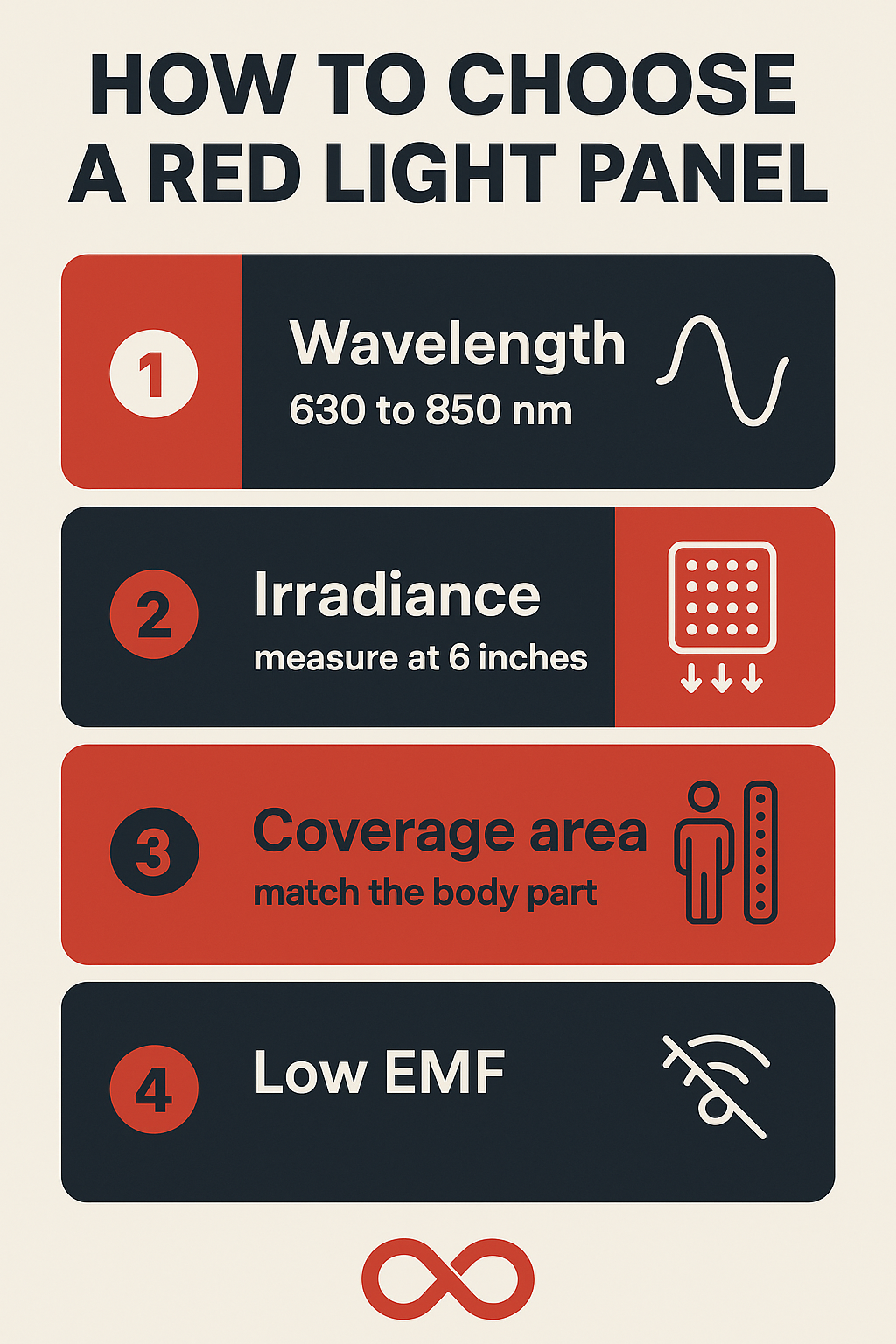
Five specifications decide whether a panel earns its space in your home. Everything else is marketing.
B2B buyers should add one more filter: service throughput. A clinic running back-to-back appointments gets more revenue per square foot from a full-body system than from three small panels, which is the same logic behind investing in professional body contouring equipment.
The most effective format is the one that delivers an adequate dose to the target tissue, consistently. In practice that means LED panels with combined red and near-infrared output for home use, because they cover large areas in one sitting and cost far less per treatment than clinic visits.
Lasers concentrate energy into a tiny spot and suit clinical procedures. Masks and belts win on convenience for one body region. Panels win on versatility, which is why they dominate this category.
Dose response is also biphasic. More is not better past a point, and research groups have repeatedly shown that overshooting energy density can blunt the effect rather than amplify it. Ten to twenty minutes per area, three to five days per week, is the standard home protocol.
For full-body treatment at home, a tower or multi-panel system such as the EMR-Tek Ultron is the practical choice. It treats front and back in two positions rather than six, which is the difference between a habit and an abandoned purchase.
If budget rules it out, the workable alternative is one large panel plus a rotation schedule: front torso Monday, back Tuesday, legs Wednesday. You still accumulate the weekly dose, just across more sessions.
Ceiling height and power supply are the two things buyers forget. Measure before you order, and confirm your circuit can handle the draw if you are looking at anything above 1,000 watts.
For face and neck, use a small, high-intensity device at a controlled distance rather than a large panel. The skin here is thin, the target depth is shallow, and red wavelengths near 630 to 660 nm do the work.
A clinical study published in Skin Research and Technology treated 20 women twice weekly for three months with 630 nm light at 15.6 J/cm2, and reported progressive improvements in skin quality that persisted a month after stopping. An earlier controlled trial by Wunsch and Matuschka found similar gains in intradermal collagen density and wrinkle appearance across a larger group.
Light alone is a slow lever. If you are serious about skin outcomes, light therapy pairs well with the resurfacing and tightening modalities in our facial machines collection, which stack mechanisms rather than repeating one.
No consumer red light panel is FDA approved. The correct term is FDA cleared, which means the device was reviewed under the 510(k) pathway as substantially equivalent to an existing legally marketed device, usually as a Class II over-the-counter device.
Many panels are instead registered or listed with the FDA, which is a lower bar and says nothing about efficacy. If a seller says approved, ask for the clearance number and the indication it covers.
Clearance also applies to a specific claim, such as temporary relief of minor muscle and joint pain. It does not validate every benefit on the marketing page.
Red and near-infrared light therapy has a strong safety record at home-use intensities. It is non-ionising, does not tan or burn at normal distances, and the common side effects are mild eye strain or a transient headache from staring into a bright array.
Protect your eyes. Wear the supplied goggles for any session where the panel is in your field of view, especially with near-infrared, which you cannot see and therefore cannot blink away from.
The evidence base is broader than skin. A systematic review and meta-analysis of randomised controlled trials found that photobiomodulation improved depression symptoms versus sham, an example of how far the research has moved beyond cosmetic claims. Talk to your clinician first if you are pregnant, photosensitive, taking photosensitising medication, or have a history of skin cancer.
This guide was written and fact-checked by the Longevity Based product team, who source, test and support every device listed above for both consumer and B2B customers. Device specifications were verified against manufacturer documentation, and every physiological claim is tied to peer-reviewed literature linked in the text.
This article is educational and is not medical advice. If you want help matching a panel to a clinic workflow or a specific goal, browse the full equipment range and ask our team before you buy.
For most people, a mid-size panel with combined red and near-infrared output, such as the EMR-Tek Firewave PRO, is the best buy. It covers a large enough zone for recovery work while staying close enough for facial sessions.
Near-infrared photobiomodulation is used clinically for tendinopathies, and gluteal tendons are a plausible target because NIR penetrates deeper than red light. Evidence specific to gluteal tendinopathy is limited, so treat it as an adjunct to loading-based rehab prescribed by a physiotherapist, not a replacement.
Medical-grade is a marketing term, not a regulatory category. The closest objective proxies are FDA clearance for a specific indication, published irradiance measured at a stated distance, and build quality to clinical standards. Several home panels meet those criteria.
Recovery and soreness effects are often noticed within one to two weeks. Skin changes follow published study timelines of roughly 4 to 12 weeks of consistent sessions, with measurable collagen changes toward the later end.
Three to five sessions per week, 10 to 20 minutes per treated area, is the standard home protocol. Daily use is acceptable at moderate distances, but longer is not automatically better because the dose response is biphasic.
Yes for any session where the array is in your line of sight. Most quality panels include eyewear, and near-infrared deserves particular care because it is invisible and does not trigger a blink reflex.
Look for a published figure measured at 6 or 12 inches rather than at the panel surface. Clinical skin protocols have used roughly 20 mW/cm2 to deliver about 15 J/cm2 in 12 minutes, which is a reasonable home benchmark.
Community threads consistently favour panels that publish third-party irradiance measurements, run low EMF, and offer a real warranty over no-name marketplace panels with inflated wattage claims. That matches our own ranking criteria.
No. Red light is visible, roughly 620 to 700 nm, and acts mainly on skin. Near-infrared is invisible, roughly 780 to 1,000 nm, and reaches deeper tissue such as muscle and joints. Most good panels emit both.
Yes. Excessive energy density can reduce the benefit rather than increase it, and very long close-range sessions can cause heating and eye strain. Follow the manufacturer distance and time guidance instead of doubling sessions.

About the author
Jacob Gendron
Jacob Gendron is a digital growth consultant at Longevity Based. He writes about professional aesthetic and fitness equipment, helping clinics, studios, and home buyers compare options and make informed purchasing decisions.


